
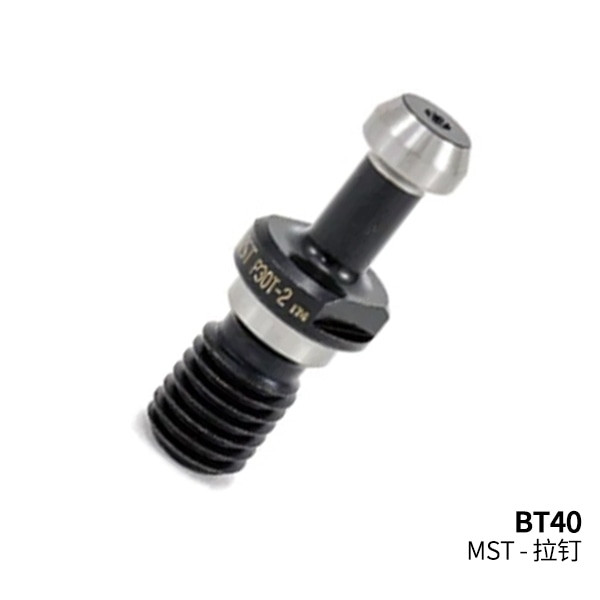
The pull stud is the cheapest part on a machining center and the one most likely to stop it dead. It carries the entire clamping force of the spindle, sits between the drawbar and the tool holder, and is routinely installed with a torque wrench nobody has calibrated since the machine was commissioned. When a pull stud fails it rarely fails politely — a neck fracture at 12,000 rpm turns a tool holder into a projectile, and a stretched stud quietly costs you tenths of runout for months before anyone notices. This guide covers what a pull stud actually does, how BT40 and CAT40 retention knobs differ, what torque really controls, and where coolant-through studs go wrong.
What the Pull Stud Actually Does
The clamping chain is short and unforgiving. Belleville washers in the drawbar push a gripper assembly back; the gripper fingers close on the stud head; the stud pulls the holder’s taper into the spindle. Every newton of holding force passes through two interfaces on the stud: the head, where the gripper fingers contact it, and the thread, where it screws into the holder.
Two consequences follow. First, the stud is a wear part, not a fastener you install once and forget — the head takes repeated impact from the gripper on every tool change, and the thread sees the full preload plus cyclic bending from cutting loads. Second, the stud is the calibration point for the whole interface: if its overall length is off by 0.05 mm, the holder seats differently, clamping force drops, and the taper starts fretting.
Why Dual-Contact Machines Care More
On a standard 7/24 taper, the holder locates on the taper alone. On dual-contact (BBT) spindles, the flange face also contacts the spindle nose, which means the stud’s length tolerance directly controls whether both surfaces actually touch. Fit a standard stud into a dual-contact machine and you get taper contact with a gap at the flange — all the stiffness benefits disappear, and the flange frets. This is the single most common mismatch we see when shops mix holders across machines.
BT40 vs CAT40 vs BT30: What Actually Differs
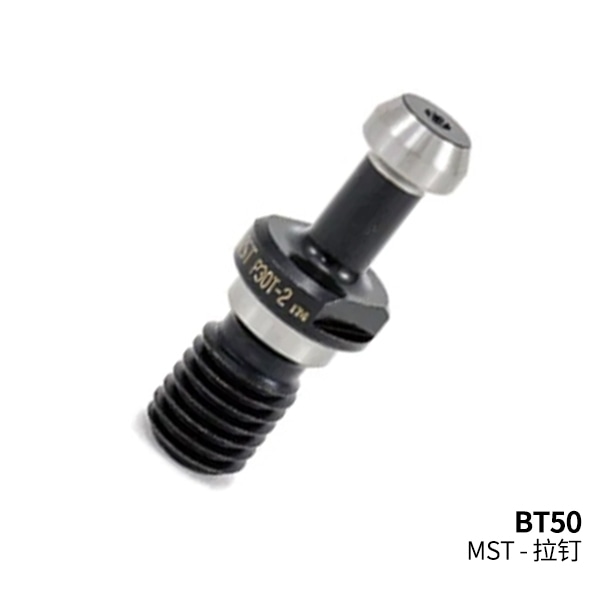
The three interfaces use different stud threads, different head geometry and different drawbar forces. They are not interchangeable, and a stud that threads in is not necessarily the right stud.
| Interface | Stud thread | Typical drawbar force | Head form | Typical install torque |
|---|---|---|---|---|
| BT30 (JIS B 6339) | M12 × 1.75 | 4–6 kN | 45° head | 30–45 N·m |
| BT40 (JIS B 6339) | M16 × 2.0 | 10–14 kN | 45° head | 70–100 N·m |
| CAT40 (ANSI B5.50) | 5/8–11 UNC | 10–14 kN | 45° head | 80–110 N·m |
| BBT40 (dual contact) | M16 × 2.0 | 14–20 kN | 45° head, tighter OAL tolerance | 70–100 N·m |
Treat the torque column as a starting range, not a rule. The stud manufacturer’s specification always wins over a generic chart, because preload depends on thread friction, plating and lubricant — variables a chart cannot see. Verify drawbar force with a spindle gauge before blaming the stud for chatter; a tired Belleville stack produces exactly the symptoms of a worn stud.
The Metric vs Inch Trap
BT40 uses M16 × 2.0; CAT40 uses 5/8–11 UNC. The two threads are close enough in diameter that a stud can be forced into the wrong holder, and close enough in appearance that mixed stock in a drawer becomes mixed stock in a spindle. Colour-code by interface, or buy studs with the interface stamped on the head. When a customer reports a stud “backing out”, the first question is always whether a CAT40 stud went into a BT40 holder with a few threads of engagement.
Coolant-Through Studs: Where They Go Wrong
A coolant-through pull stud has a central bore that feeds coolant from the drawbar through the holder to the tool. The seal usually sits at the flange face or on the stud neck, and it is the seal — not the bore — that decides whether the setup works.
When You Actually Need One
Through-spindle coolant pays for itself in deep-hole drilling, small-diameter tools, and any operation where you cannot aim a nozzle at the cutting edge. If your process runs external flood coolant only, a coolant-through stud adds a leak path and nothing else.
The Three Failures We See Most
- Mixed stud types in one magazine. Fit coolant-through studs on some holders and blank studs on others, and every tool change dumps coolant out of the open holder onto the taper. The fix is to standardise the whole magazine.
- O-ring material chosen for temperature, not chemistry. Nitrile seals swell and harden in some coolant concentrates; Viton costs little more and lasts. Replace seals on a schedule, not on failure.
- Pressure beyond the seal’s rating. High-pressure coolant systems (50–70 bar and above) need studs rated for that pressure, with the correct seat geometry. A standard stud at 70 bar leaks into the spindle taper, and coolant sitting in a taper is how you get fretting corrosion and inconsistent tool seating.
Torque: The Number Everyone Gets Wrong
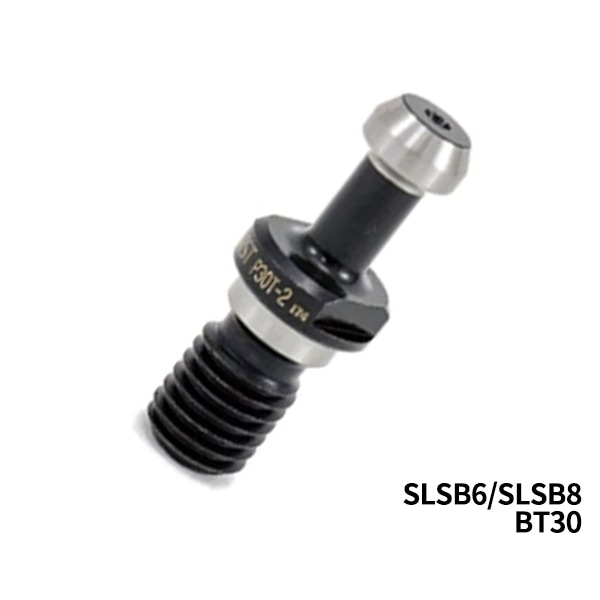
Torque does not clamp the holder — the drawbar does. What stud torque controls is preload: the tension that keeps the stud from moving under cyclic load. Get it wrong in either direction and the failure is predictable.
Too Little
Under-torqued studs relax, then back out. The symptom is gradual: runout creeps up, the holder seats deeper, tool life drops, and eventually the stud unthreads inside the spindle. Shops that “snug it by hand” are the same shops that replace spindles early.
Too Much
Over-torque strips the holder thread — usually the weaker member — or yields the stud neck. It also makes the torque reading meaningless on the next install, because a stretched stud and a dirty thread both read low. A stud that has been over-torqued once should be replaced, not reused.
Thread Condition Changes Everything
Dry threads, oiled threads and thread-locker produce preload differences of 20–30% at the same torque value. Pick one procedure and write it down: clean the thread with solvent, apply the specified lubricant (or none), torque to the stud maker’s figure with a calibrated wrench. Recalibrate the wrench annually — an uncalibrated wrench is the most expensive free tool in the shop.
Failure Modes and a Practical Inspection Routine
Pull studs fail in five recognisable ways: neck fatigue fracture, head flattening, thread stretch, coolant corrosion, and gripper-induced wear on the 45° angle. Fatigue fracture is the dangerous one and almost always has a cause upstream — excessive runout, a bent stud, wrong length, or a drawbar that has lost force.
A Ten-Minute Check, Once a Quarter
- Measure overall length against the interface spec; a stud that has grown is stretched and must go.
- Inspect the head under magnification for flattening, brinelling or a polished band where the gripper has been slipping.
- Check the thread for galling and the neck for cracks — dye penetrant on a sample batch is cheap insurance for high-speed spindles.
- Verify drawbar force with a gauge; if force has dropped more than 15% from the machine builder’s figure, rebuild the drawbar before replacing studs.
- Log install dates. A two-year replacement interval for production machines, or per 8,000–10,000 tool changes, is a reasonable default until your own data says otherwise.
What to Put on the Purchase Order
- Interface and standard (BT30 / BT40 / CAT40 / BBT40), plus the stud maker’s part number
- Thread specification and class, not just “M16”
- Overall length and its tolerance — especially critical for dual-contact spindles
- Material and hardness: through-hardened alloy steel with a specified core and surface hardness range
- Coolant-through: bore diameter, seal material (Viton for most coolant concentrates), rated pressure
- Head form matched to your gripper fingers — 45° is standard, but verify against the drawbar drawing
- Batch traceability and a stated install torque
Bottom Line
Buy pull studs the way you buy tool holders: to a specification, from a supplier who stocks the exact interface and can tell you the torque and length tolerance in writing. Match the stud to the spindle (standard versus dual contact), standardise coolant-through versus blank across the whole magazine, torque with a calibrated wrench to the maker’s figure, and inspect on a schedule instead of on failure. The part costs a few dollars; the failure costs a spindle.
SCZY supplies pull studs and retention knobs for BT30, BT40, CAT40 and BBT40 interfaces, in standard and coolant-through versions, with batch traceability and interface-marked heads — alongside our tool holder, collet and workholding lines. Tell us your spindle interface, drawbar force and coolant pressure, and we will confirm the correct stud specification before you order. Send your requirements here.



