On a vertical machining center, your spindle stops every time an operator opens the door to swap parts. On a horizontal machining center, that dead time mostly disappears — and the tombstone is the workholding component that makes it happen. A tombstone for horizontal machining is a heavy four-sided column bolted to a pallet, giving you multiple part faces presented to the spindle one after another while a second pallet is being unloaded and re-fixtured right next to the machine. This guide explains how tombstones work, how to choose the material, how grid plate hole patterns determine your fixturing flexibility for years, and how to plan a dense, safe layout that actually earns back the investment.
What a Tombstone Is (and What It Is Not)
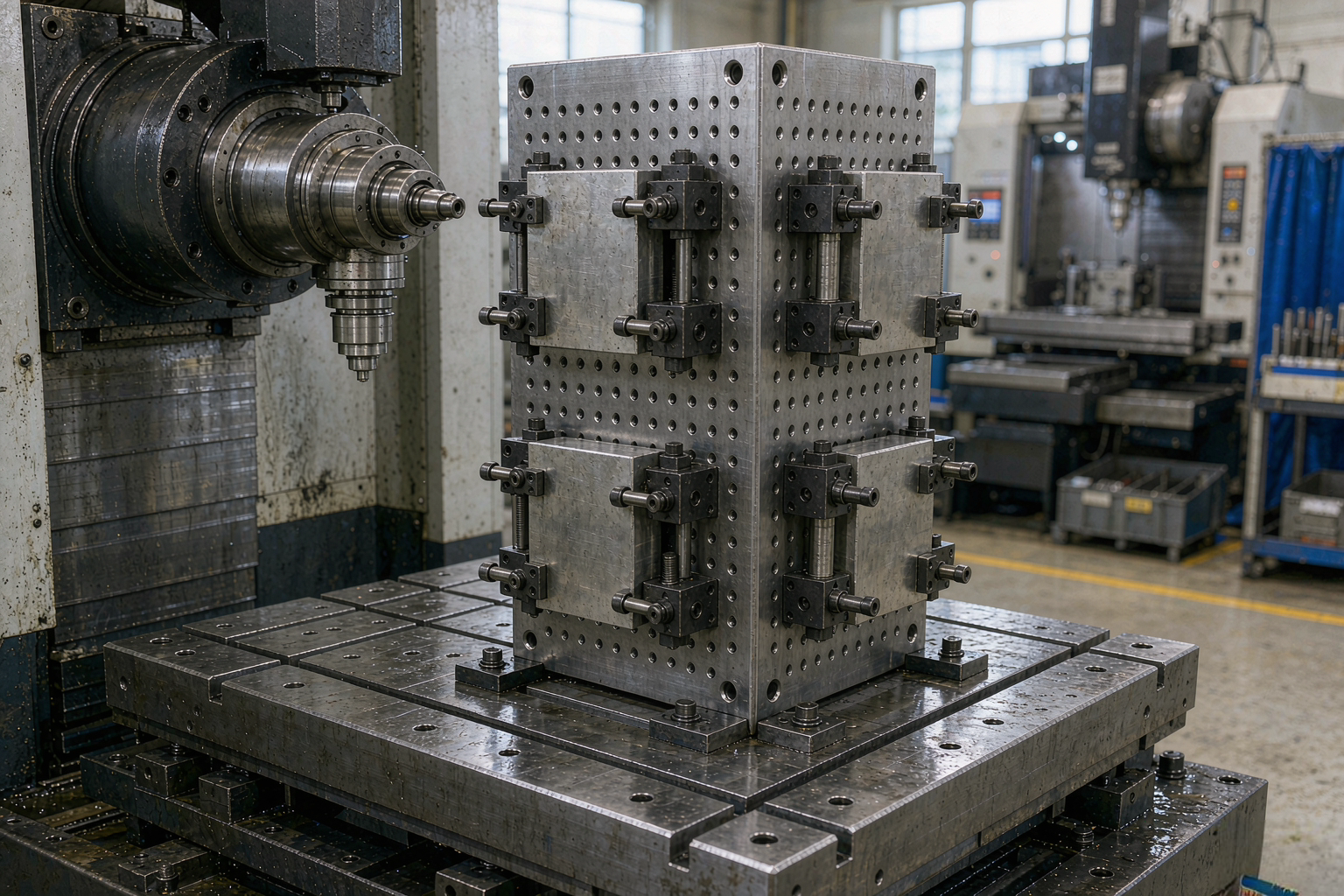
A tombstone — sometimes called a riser, monument or tooling column — is a precision-machined block, usually square or rectangular in cross-section, mounted vertically on the pallet of a horizontal machining center. Each of the four vertical faces carries its own set of workpieces or fixture elements. As the pallet indexes in 90-degree steps, the spindle machines face after face without anyone touching the parts.
It is not simply a block of metal. A production-grade tombstone is stress-relieved, ground flat on every working face, and drilled with a systematic grid of locating and clamping holes. The squareness between adjacent faces and the flatness of each face determine whether parts machined on side A end up in the same coordinate frame as parts on side C. Cheap blocks with sloppy squareness quietly eat your tolerance budget before the cutter ever touches the workpiece.
Why Four-Sided Fixturing Changes the Economics
The core argument for a tombstone is spindle uptime. On a VMC, the spindle typically cuts somewhere between 40 and 55 percent of the open hours once door opening, part loading and tool changes are counted. A horizontal center with a two-pallet changer and tombstones keeps one pallet in cut while the other is staged outside:
- Pallet swaps take well under a minute, often around 30 seconds.
- Load and unload time moves fully off the critical path — the operator fixtures parts while the machine cuts.
- Four faces let you run one part on each side, or pack six small parts per face.
- Indexing between faces replaces operator intervention, so lights-out batches become realistic.
The result is spindle utilization that can climb to 85 percent or higher. That is the payback number to model when you price a tombstone and its fixture hardware: not the cost of the column, but the machine-hours it converts from idle to cutting.
https://www.sczymfg.com/wp-content/uploads/2026/11/tombstone-hmc-hero.png
Tombstone Materials: Steel, Cast Iron or Aluminum
The three common choices are mild or medium-carbon steel (1045 or 1018), gray cast iron, and aluminum (6061 or 7075). Each trade is real, and the wrong pick shows up as chatter, drifting holes or a pallet that cannot accelerate properly.
| Property | Steel (1045) | Gray Cast Iron | Aluminum (6061) |
|---|---|---|---|
| Vibration damping | Moderate | Excellent (graphite flake structure) | Poor |
| Mass per volume | High | High, slightly lighter than steel | Roughly one third of steel |
| Threaded hole durability | Excellent, resists stripping | Good, but threads wear with heavy re-fixturing | Fair — use helicoils in high-cycle holes |
| Rust resistance | Needs oil or coating | Good in dry shops, can stain parts | Excellent |
| Cost | Moderate | Moderate to high in small quantities | High per stiffness, cheap to machine |
| Best suited for | General production, heavy clamping forces | Finishing work, chatter-prone thin walls | Large tombstones near pallet load limits, fast indexing |
For most job shops, steel is the default: durable threads, reasonable damping, and the widest availability of standard sizes. Cast iron earns its premium when you finish critical features on the tombstone and every bit of damping helps surface finish. Aluminum makes sense when the tombstone is very large and the pallet actuators, or the pallet itself, have a load rating you cannot exceed.
Grid Plate Hole Patterns: The Interface That Decides Flexibility
The hole pattern on the tombstone faces and on the machine pallet is the real interface standard of your workholding system. It decides which vises, clamps and sub-plates you can bolt on for the next decade. The dominant patterns:
50 mm grid
The most common metric standard on Japanese and Chinese horizontals. Holes are on 50 mm centers, usually 16 mm in diameter, fitted with hardened dowel bushings for locating pins. Buy vises and modular clamps whose mounting slots match the 50 mm pattern and everything you own becomes interchangeable across tombstones and sub-plates.
62.5 mm and inch grids
Many US-built horizontals use a 62.5 mm (2.5 inch) or one-inch grid. If you are quoting a used machine, check the pallet pattern before ordering any tombstone — this is the single most common ordering mistake, and adapter plates eat stack-up tolerance and stiffness.
Dowel and locating holes
A good tombstone face mixes clamping holes with precision reamed dowel holes. The dowels carry the position; the bolts only hold the fixture down. For repeatability part-after-part, dowel-located fixtures beat edge-clamped ones every time.
Matched hardware, matched patterns
Decide one pattern, then hold the line. Mixing patterns on one machine creates a drawer full of adapter plates and a workforce that quietly stops using half your fixturing inventory.
Planning the Layout: Vises, Grid Clamps or Dovetail Tabs
Layout planning is where tombstone projects succeed or fail. Work backwards from the machine, not the part:
- Check the envelope per face. Y-axis travel divided by the number of tombstone faces gives the working height available per side; X travel sets row width. A 500 mm class HMC with a 400 mm tombstone may only offer 300 mm of usable machining height per face once tool clearance is counted.
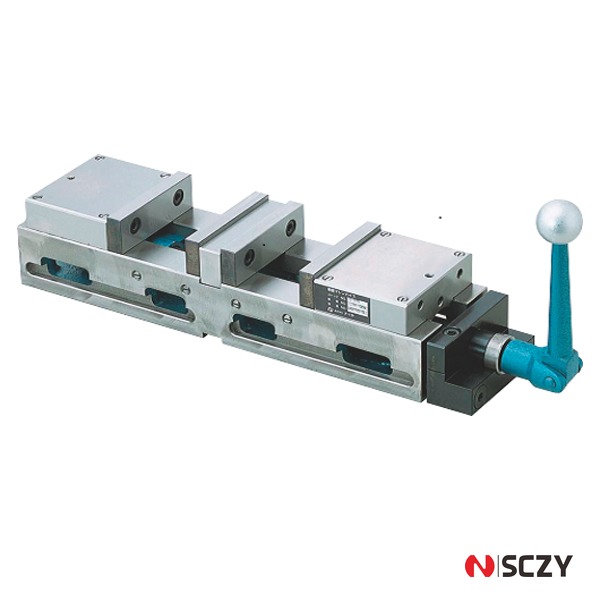
- Choose the clamp by part geometry. Rectangular blocks love double-station vises; thin plates and housings love grid clamps with edge stops; five-sided aerospace parts love dovetail tabs machined into the blank.
- Jam the parts, not the tools. Pack parts tightly for density, but leave room for the tool to reach the last feature without gouging the neighbor. A layout that requires 300 mm of tool overhang to clear an adjacent vise will chatter and break cutters.
- Plan the first operation somewhere. Every part needs a datum face before tombstone ops; that blank preparation happens on a saw, a VMC or the first pallet station.
- Leave a cutoff and unload path. Parts that machine beautifully but cannot be removed from the tombstone without unbolting three clamps destroy the cycle time you gained.
Hydraulic and Pneumatic Vises on Tombstone Faces
Once layouts get dense and batches get long, manual vise screws become the bottleneck. Production tombstone cells increasingly run hydraulic or pneumatic vises: clamping force becomes repeatable part-to-part, an operator can clamp an entire face with one lever or one solenoid valve, and force stays available through thermal shifts where a hand-tightened screw slowly relaxes.
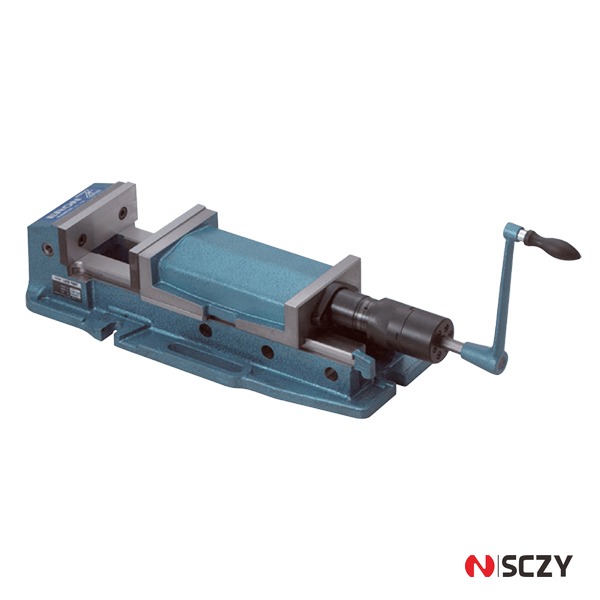
Double-station vises multiply density further: two parts per unit, mirrored jaws, and a pattern that tiles neatly down the tombstone face. The trade-offs are plumbing (hoses or internal passages to route on the pallet) and force discipline — hydraulic force high enough to distort a thin-walled casting is a scrap generator, not a productivity feature.
Zero-Point Location Between Pallets
The last piece of the system is how fixtures return to position after every pallet swap. Zero-point clamping receptors mounted in the tombstone and pallet let pre-fixture sub-plates drop in and lock with a few microns of repeatability. The payoff: a second set of sub-plates can be loaded with the next job while the current one runs, converting even the fixture changeover into off-line work. Confirm the repeatability spec against your true position tolerances — cheap systems quote repeatability under lab conditions that a chip-laden pallet will not reproduce.
Chips, Coolant and the Horizontal Advantage
Tombstones and horizontal spindles solve machining’s oldest hygiene problem: chips fall away from the feature instead of nesting inside it. Coolant washes chips down into the trough, the next face presents a clean clamping surface, and re-cutting of chips — a major source of finish problems and tool wear on VMCs — largely disappears. Use that advantage: aim coolant lines at the tombstone face junctions where pockets of chips accumulate, and flush pallets between cycles on aluminum jobs where built-up swarf shifts part locations.
A Practical Buying Checklist for a Tombstone
- Pallet interface and bolt pattern matches your machine (verify before ordering, not after).
- Grid hole pattern — 50 mm or 62.5 mm — matches your existing and planned vises and clamps.
- Material chosen for damping, mass limits and thread cycle life, not just price.
- Flatness, squareness and parallelism certifications supplied with the block.
- Hardened bushings and reamed dowel holes, not plain drilled holes, on locating positions.
- Total mass including fixtures and workpieces under the pallet load rating.
- Through-voids or relief slots if you machine long parts that overhang the column.
- Stress relief stated by the supplier — untreated blocks distort over the first year.
Bring Your Workholding Questions to SCZY
SCZY supplies precision workholding and machine tool accessories — vises, magnetic chucks, tool holders and metrology equipment — to machining companies worldwide, and we help customers plan tombstone and grid-plate fixturing around the machines they actually run. If you are moving parts from a VMC to a horizontal center, or your current tombstone layout is fighting your tooling instead of supporting it, talk to us at https://www.sczymfg.com/aboutus/ and we will help you spec the right column, pattern and clamp package for your parts.