
Every shop eventually breaks a tap — usually at 4:40 on a Friday, halfway through the last op on a part that already carries three hours of machining. The post-mortem almost always blames the tap. In most of the cases we see, the tap was fine — the tap holder was the wrong type for the hole, the material, or the machine’s synchronization accuracy.
A tap is the only common cutting tool that is fed by its own geometry. The thread pitch dictates how fast the tool must travel per revolution, and the machine has to match that number exactly, every revolution, in both directions. A tap holder is the interface that absorbs whatever error the machine, the control, and the setup introduce. Choose it well and tapping becomes boring. Choose it badly and you spend the afternoon with a broken-tap extractor.
Why Tapping Fails More Often Than Milling
Milling is forgiving. If the feed rate is 3% off, the chip load changes slightly and you adjust the speed. Tapping is not forgiving, because the tool and the machine are fighting over the same axial position.
Axial Sync Error Becomes Thread Pitch Error
Assume a synchronization error of only 0.01 mm per revolution — a number most machine builders would call “well within spec.” Over the 100-plus revolutions required for a 20 mm deep M8 hole, that error accumulates into roughly a millimetre of axial conflict between where the tap wants to be and where the spindle puts it. Something has to give: the tap shank stretches, the thread flanks get burnished and torn, or the tap snaps at the neck.
This is the entire reason floating tap holders exist. They do not improve the machine. They give the mismatch somewhere to go.
Chips Have Nowhere to Go
In a blind hole, a spiral flute tap pushes chips backwards up the flutes. In a through hole, a spiral point tap pushes them forward. Get the geometry wrong, or tap without pecking in a gummy material, and the chips pack into the flutes until the torque spikes. No holder saves a packed flute, but a holder with overload protection at least stops the damage at one tap instead of a fixture.
The Three Ways to Hold a Tap in a CNC Spindle
1. Tension-Compression Tap Holders (Float Holders)
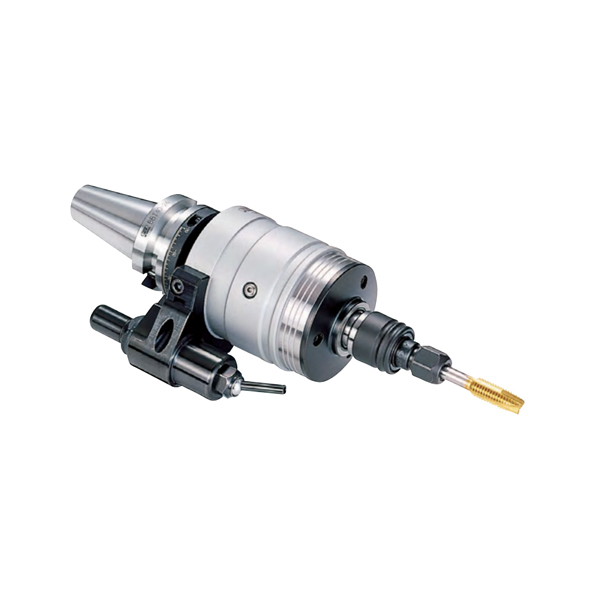
A tension-compression holder — often called a floating or axial-float tap holder — contains a spring-loaded assembly that allows the tap to move a short distance in and out of the holder. Typical axial float is on the order of 0.5–1.5 mm in compression and 0.3–0.5 mm in tension, depending on size and series. When the spindle leads or lags the thread pitch, the holder takes up the difference instead of the tap.
These are the safe default for older machines, for drilling and tapping centers without synchronous feed, for tapping heads on radial drills, and for any job where a broken tap means scrapping an expensive part. The trade-offs: you lose some depth repeatability, the float limits how fast you can run, and blind-hole depth needs a margin of at least one pitch beyond the float.
2. Rigid Tap Holders
A rigid holder clamps the tap shank and square drive with zero axial compliance. All synchronization comes from the machine. Rigid holders are shorter, stiffer and cheaper than float holders, and they hold thread depth and position far more consistently. They are also the fastest option when the machine can genuinely hold sync.
On a machine with poor sync, a rigid holder is the fastest way to break small taps. If you hear a tap squeal on reversal, or see the first two threads of a hole torn, the holder is telling you the machine cannot keep up.
3. Synchronous Tapping with Rigid Holders (G84 / Synchro Mode)
Modern controls offer a synchronous tapping cycle — G84.1 or a dedicated synchro mode depending on the builder — where spindle rotation and Z-axis feed are interpolated by the same motion controller rather than commanded separately. Combined with a rigid holder, this gives the best combination of speed, depth accuracy and thread quality.
Synchronous tapping is standard on most VMCs built in the last fifteen years, but verify it rather than assume it: the synchro option must be enabled, the spindle needs an encoder, and the pitch must be entered in the cycle rather than an approximate feed rate worked out by hand.
How the Three Setups Compare
| Holder type | Axial compensation | Sync requirement | Best for | Main risk |
|---|---|---|---|---|
| Tension-compression (float) | Typically 0.5–1.5 mm compression, 0.3–0.5 mm tension | None — absorbs mismatch | Older machines, blind holes, high-value parts, tapping heads | Depth scatter; broken taps if float bottoms out |
| Rigid | None | Good machine sync | Production holes with tight depth tolerance | Tap breakage when sync drifts |
| Rigid + synchronous cycle | None | Encoder and synchro option required | High-speed production, small taps, deep holes | Setup error if pitch is typed wrong |
| Quick-change with torque clutch | Depends on insert | Matches insert type | Frequent size changes, mixed batches | Clutch too loose gives shallow threads |
| Tapping head (multi-spindle / attachment) | Full float plus clutch | None | Drill presses, gang tapping, legacy equipment | Bulk and reach limits on compact machines |
Matching the Holder to the Hole, the Tap and the Material
Through Holes vs Blind Holes
Through holes are the easy case: spiral point tap, rigid or synchro holder, full depth, chips exit ahead of the tool. Blind holes are where holder choice pays for itself. A spiral flute tap needs room for chips to reverse, and a float holder adds axial travel you must account for. In a blind hole with 1.5× diameter thread depth, order the holder with the smallest float that will still absorb your machine’s error — or move to synchronous tapping and remove the variable entirely.
Form Taps and High-Torque Materials
Thread-forming (cold-forming) taps produce no chips, which makes them ideal for blind holes in ductile materials, but they need roughly 1.5–2× the torque of a cutting tap because they displace material rather than remove it. That torque has to be transmitted through the square drive, not just the shank. On stainless, duplex alloys and high-tensile steels, use a holder with a torque clutch and set it just above the expected peak — a form tap that slips will produce an undersized thread that passes a go gauge and fails under load.
The Shank Interface: BT30, BT40, BT50, CAT and HSK
Tap holders follow the same taper families as every other tool holder, and the taper you already run determines what you can buy off the shelf. BT30 and BT40 cover the majority of tapping work on vertical machining centers up to about 10,000 rpm. BT50 and CAT50 suit heavy taps and large-diameter threads on horizontal machines. HSK-A63 and HSK-A100 appear where high spindle speeds and short, rigid tapers matter.
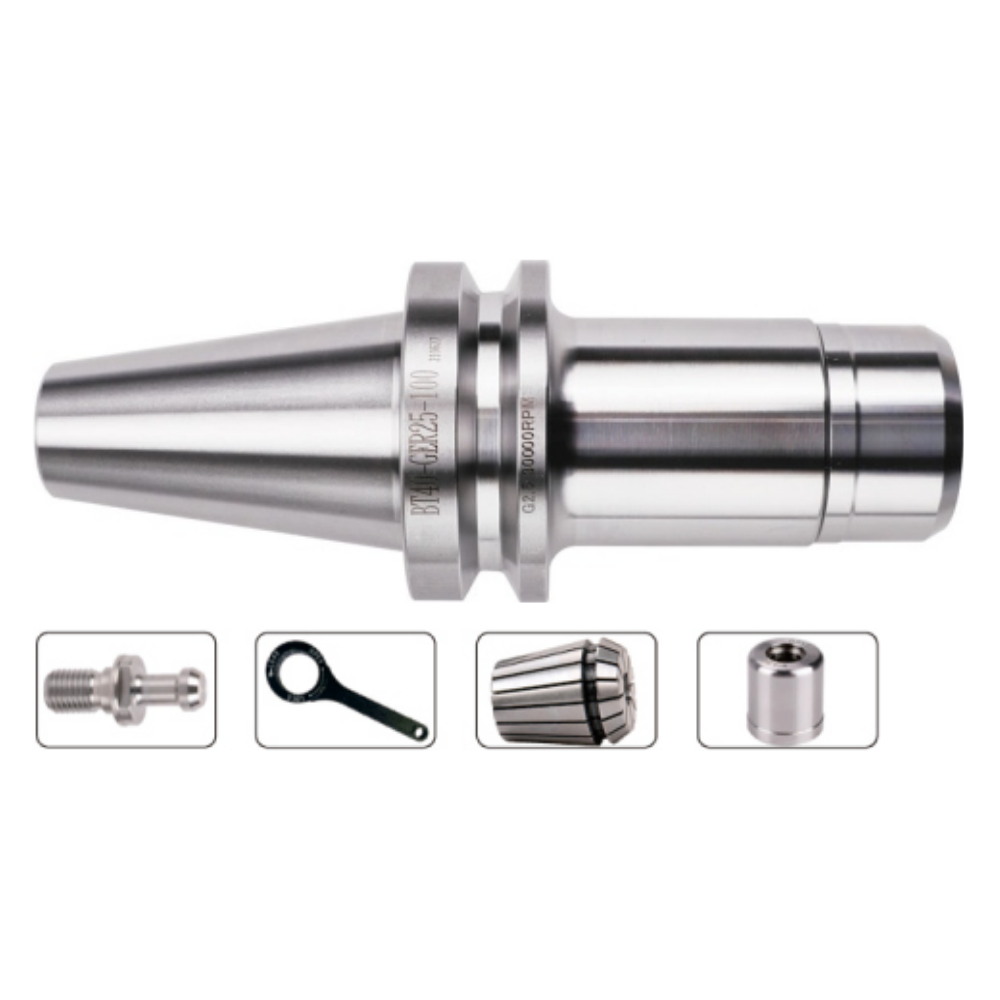
Two interface details are worth checking before you order. First, dual-contact (BBT) tapers need a matching spindle face and a pull stud of the correct length — a standard BT pull stud in a BBT spindle leaves the holder sitting off the face and destroys the fit. Second, check the balance grade if the same holder will also run small tools at high speed.
Coolant, Speed and Setup Details That Decide Tool Life
Coolant Delivery
Flood coolant aimed at the hole entrance does very little for a tap 15 mm deep. Internal coolant through the holder and tap is far more effective, particularly in horizontal setups and in deep blind holes where chips need flushing out. If your taps have coolant holes, specify a coolant-through holder with the correct sealing — a missing O-ring turns a through-coolant setup into a flood of coolant around the spindle nose.
Speed and Feed Starting Points
These are starting points, not recipes. Verify against your tap supplier’s data for the specific coating, geometry and material condition.
- Mild steel, M6–M10, synchro: 300–600 rpm, cutting tap, flood or through coolant.
- Aluminum, M4–M8: 800–1500 rpm, spiral flute, generous coolant, watch for built-up edge.
- Stainless 304/316: 150–300 rpm, sharp spiral flute tap, high-pressure coolant, never let the tap dwell.
- Form tapping in steel: roughly 50–70% of the cutting-tap speed, with torque monitoring enabled.
Always tap with the shortest holder that reaches. Every extra 20 mm of gauge length adds deflection, and deflection shows up as a tapered thread rather than an obvious tool problem.
Common Failures and What They Actually Tell You
- Tap breaks on reversal, not on entry. Sync error, or a float holder that has bottomed out in tension. Check the return feed and the available float travel.
- Thread is tight at the bottom of a blind hole. Chip packing, or a spiral point tap used where a spiral flute was needed.
- First two threads torn. Holder running out, or the tap entering off-axis because the holder face was not seated cleanly.
- Tap slips in the square drive. Worn square, undersized drive, or a clutch set below the torque a form tap needs.
- Depth varies from hole to hole. Expected with float holders; switch to rigid plus synchro if depth is critical.
What to Specify When You Order Tap Holders
A tap holder is not a generic item. Send your supplier four things and you will get the right part the first time:
- Machine taper: BT30, BT40, BT50, CAT40 or HSK-A63, and whether the spindle is dual contact.
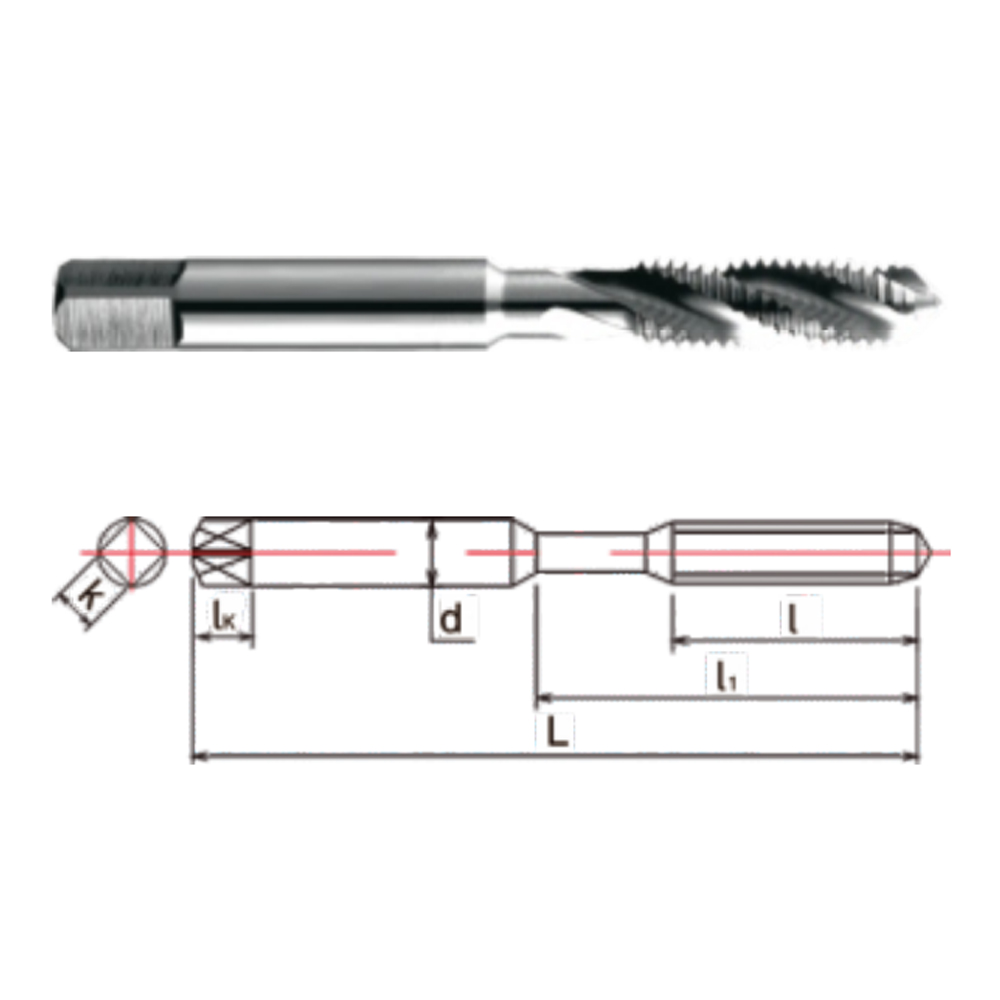
- Tap shank and square: for DIN 371 taps the square is typically 4.9 mm at M6, 6.2 mm at M8 and 8.0 mm at M10. Give the tap standard, not just the thread size.
- Holder type and float: rigid, tension-compression with a stated float range, or quick-change with a named insert series.
- Coolant and protection: through-coolant or external, plus whether you need a torque clutch and what torque window it must cover.
Buy the Interface, Not Just the Holder
The tap holder is the part of the tapping system that absorbs everything the machine cannot control. Get the type right — float where there is uncertainty, rigid plus synchro where repeatability matters — and most of the tapping problems in a shop disappear without changing a single tap. Get it wrong and you keep replacing good taps.
SCZY supplies tap holders across BT30, BT40, BT50, CAT and HSK interfaces, in rigid, tension-compression and quick-change configurations, with through-coolant options and torque clutches matched to your tap standard. If you are unsure which float range or clutch setting your operation needs, send us the hole depth, the material and the tap standard, and we will specify the holder around them rather than sell you a catalogue number. Tell us what you are tapping and we will come back with a recommendation and a quotation.



