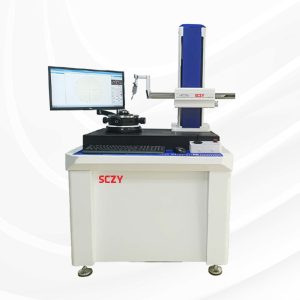
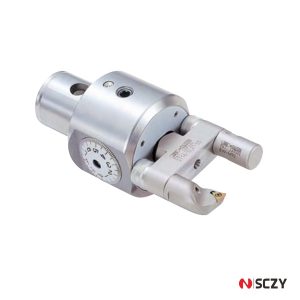
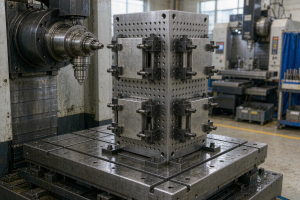
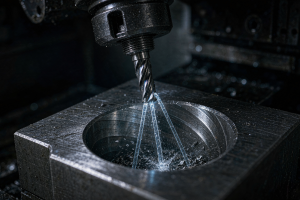
When a part has a deep pocket, a tall rib, or a cavity the cutter must reach 150 mm below the workpiece surface, a standard length tool holder becomes the weakest link in the process. A long reach tool holder — also called an extended nose or slim profile holder — is designed to deliver cutting torque and accuracy at that distance without stacking adapters or sacrificing rigidity. Choosing one well is less about the holder itself and more about understanding how every millimeter of reach amplifies runout, deflection and unbalance at the cutting edge. This guide breaks down the physics, compares the four common long reach options, and lists what to verify on your machine before you order.
Where Standard Holders Stop Working
Most BT40 or CAT40 collet chucks are designed with a compact nose so the spindle-to-workpiece clearance stays small. Problems appear in mold and die work, aerospace ribs, pump housings and deep bores where the spindle nose, holder body or even the ATC arm would collide with the part before the cutter reaches depth. The moment you need 100–300 mm of projection, three separate error sources grow with the added length:
- Runout amplification. A taper-to-nose runout of 5 µm on a short holder may read 10–15 µm at the tool tip of an extended one, because eccentric mass and cantilever effects add geometric error on top of the measured value.
- Deflection. Bending stiffness falls with the cube of overhang. Doubling projection cuts stiffness to one eighth; a cut that was stable at 60 mm can chatter badly at 120 mm with the same tool and holder.
- Unbalance. Extended bodies have more mass far from the rotation axis, so the same balance grade produces larger centrifugal force, and the resonant frequency of the assembly drops into the operating speed range more easily.
A long reach holder is engineered specifically to control these three effects: a slender but concentric body, minimal projected mass, and a clamping interface that keeps the tool itself from adding runout.
The Four Long Reach Options Compared
Shops typically choose between an extended nose ER collet chuck, a slim hydraulic expansion holder, a long shrink fit holder, or the budget route: a standard holder plus an extension adapter. The table below compares them on the parameters that matter most in deep cavity work.
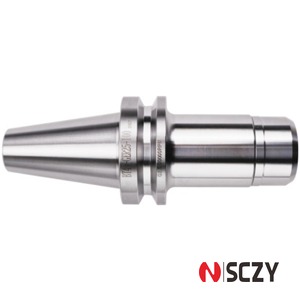
| Criterion | Extended-nose ER collet chuck | Slim hydraulic holder | Long shrink fit holder | Standard holder + extension adapter |
|---|---|---|---|---|
| Typical TIR at tool tip | 10–20 µm | ≤ 3–5 µm | 2–5 µm | 15–30 µm (two joints) |
| Projection available | 100–250 mm | 100–300+ mm (slim types) | Up to 300 mm in one piece | Stacked, any length |
| Damping capacity | Low | High (oil film) | Low–medium | Low, joint adds play risk |
| Tool shank flexibility | Any ER size range | One bore per holder | One bore, exact H6/h6 fit | Whatever the host holder takes |
| Balance grade achievable | G6.3 at moderate rpm | G2.5 practical | G2.5–G6.3 | Harder — joint concentricity varies |
| Relative cost | Low | High | Medium–high | Lowest upfront |
Extension Adapter vs One-Piece Long Reach Holder
The extension adapter looks like the cheapest way to buy reach, and for occasional, low-precision holes it is. But an adapter stacks a second taper joint in series between spindle and tool, and every joint adds three penalties:
Two tapers in series compound runout
Each taper interface carries its own concentricity tolerance, typically 5–10 µm. Worst case they add arithmetically: a 7 µm holder bore plus a 6 µm adapter bore can deliver 13 µm at the adapter nose before the tool is even clamped. One-piece long reach holders keep a single ground taper, which is why their tip runout specs are routinely 3–5 times better.
The joint is a damping hole
Under varying cutting load, a taper joint micro-slides — the same fretting mechanism that damages spindle tapers. In practice this means the adapter route chatters earlier, and repeated heavy cuts can fret both tapers permanently. If you must use an adapter, torque the draw bolt to spec, keep the joint clean and dry, and re-check runout weekly.
Mass where you don’t want it
Adapters are cylinders of steel placed exactly where mass hurts most: between the spindle and the tool. A one-piece slim holder removes that parasitic mass and lowers the assembly’s resonant frequency penalty.
Why Hydraulic Damping Wins Deep Cavity Finishing
In deep cavity semi-finishing and finishing, chatter — not torque — is usually the limiting factor. This is where the slim hydraulic holder earns its price. The thin oil sleeve that clamps the tool also acts as a tuned damper: it dissipates vibration energy at the tool shank instead of letting it ring through the holder. Shops moving from an ER chuck to a slim hydraulic long reach holder typically gain one or two depth-of-cut steps in a chatter-limited wall pass, and the surface finish improvement often eliminates a manual polishing operation.
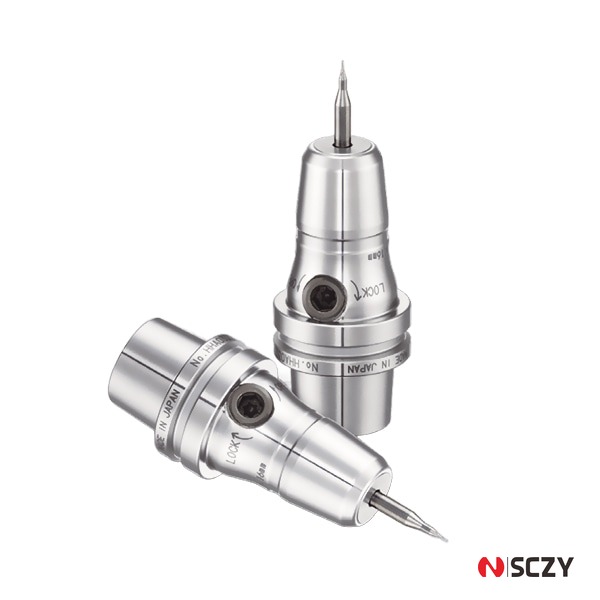
The trade-offs are real: one bore size per holder, careful torque discipline on the clamping screws, and no Weldon flats. For roughing at high torque a side lock or power milling chuck remains the better tool; for reach plus finish, hydraulic is hard to beat. Our detailed comparison of hydraulic tool holder damping and maintenance covers refill oil, sleeve limits and clamping torque in depth.
Check Your Machine Before You Order
A long reach holder only pays off if the machine side is healthy. Before committing to a batch of extended holders, verify:
- Drawbar force. A worn spring pack delivers less retention force just where more is needed. Measure it; don’t assume.
- Spindle taper condition. Blue-check the taper contact. Fretting or a bell-mouthed bore multiplies the errors you paid to avoid.
- Clearance geometry. Model the worst-case part: spindle nose radius, holder body diameter at each depth, and ATC swing path all matter. A slim 32 mm body may clear where a 50 mm body stalls the job.
- Max rpm vs balance grade. Extended assemblies should be balanced as a unit — holder, nut, tool — to at least G6.3, G2.5 for finishing spindles above 15,000 rpm. See our tool holder balancing guide for the ISO 21940 conversion.
Failure Modes to Watch on the Floor
Long reach holders fail in recognizable patterns. Catch them early and a cleaning or re-torque saves the setup; ignore them and you scrap a cavity wall three hours into a cut.
- Progressive runout drift usually means swarf packed in the collet or bore. Clean on a schedule, not on a whim.
- Chatter that appears after a tool change points to a nicked taper or an over-torqued nut; check TIR at the tip with the tool clamped exactly as it runs.
- Finish taper at depth but clean at the top is classic deflection: reduce radial engagement or step down in axial depth rather than fighting it with feed.
- Pull-out marks on the shank mean the clamping interface is overloaded for the torque — move to hydraulic, shrink fit or a side lock for that operation.
The same overhang-cubed physics governs boring bars; if your deep feature is a bore rather than a pocket, our boring bar overhang and deflection guide applies the same rules to internal turning.
Ordering Checklist
- Required projection and body diameter at maximum depth, from the clearance model.
- Tip TIR spec in writing, measured at tool tip with tool clamped — not at the taper.
- Balance grade and max rpm rating for the full assembly.
- Clamping type matched to the operation: collet for flexibility, hydraulic for finish, shrink fit for one-piece rigidity, side lock for torque.
- Spare nut, seals and wrenches on hand — a long reach holder out of service idles the whole deep-cavity job.
SCZY supplies extended nose collet chucks, slim hydraulic holders and the full BT/HSK tool holder program for mold, die and deep cavity machining, with runout and balance data available per batch. If you are fighting reach, runout or chatter on a specific part, send us the drawing and cutting parameters and we will recommend the holder geometry that reaches the feature without reaching the limit of your process.