
If your shop runs BT40 spindles and you are chasing better surface finish, longer tool life or heavier cuts, someone has probably told you to “move to dual contact.” A BBT40 dual contact tool holder looks almost identical to a standard BT40 holder: same 7:24 taper, same pull stud, same 40-taper envelope. Yet it changes how the whole tooling stack behaves, and the reason sits in a few microns of contact that nobody sees from the operator panel.
This guide is for shop owners and process engineers deciding whether a BBT40 conversion is worth the money: what dual contact adds, what it demands from the machine, and where it quietly wastes budget.
What Dual Contact Really Changes
Every 40-taper interface is a cone being pulled into a socket. The question is which surfaces are allowed to touch.
Standard BT40: taper contact only
On a standard BT40 spindle the holder is located and clamped on the taper alone. The flange face stops a fraction of a millimetre short of the spindle nose, so the taper carries radial location and most of the bending load. That is fine for the vast majority of work, and it is why BT40 has survived for decades.
The limitation shows up when the load path gets long. A holder hanging 150 mm out of the spindle acts as a lever, and all of that bending moment funnels into a cone roughly 40 mm across. Deflection at the tool tip grows, taper contact pressure becomes uneven, and over thousands of cycles you get the classic wear pattern: bell mouthing at the large end of the holder taper, fretting marks in the spindle bore, and a Z-offset that drifts a few microns between tool changes.
BBT40: taper plus flange face
A BBT40 holder is machined so the flange face and the taper seat simultaneously. The taper still centres the tool, but the flange now provides a second, much larger annular contact area that takes axial load and resists bending. This is what the industry calls dual contact, and it is the defining feature of the BBT40 dual contact tool holder family.
In practice the difference shows up in four places:
- Stiffer tool tips at long gauge lengths. Two contact surfaces share the bending moment, so a long-reach holder deflects less under the same cut.
- More repeatable Z. The flange gives a hard axial stop, which reduces length variation after tool changes.
- Less taper movement under load. Because the holder cannot rock on the cone, fretting and bore scoring progress more slowly.
- Higher usable cutting loads. Heavier radial engagement and harder materials become feasible without chatter taking over.
None of this is free. Dual contact moves the compliance problem from the taper to the spindle face, and that is exactly where the upgrade gets interesting, and where many conversions fail.
Four Interfaces That Must Match
A dual contact holder is only half of a dual contact system. The spindle has to be built, or reworked, to present a flat face that the holder flange can seat against. If any of the following is out of tolerance, the holder behaves like an expensive standard BT40.
1. Spindle face flatness and squareness
The spindle nose face must be flat and square to the taper axis within a few microns. A spindle ground for taper-only contact may have a face that is merely clean, not flat. Bolting dual contact holders into such a spindle gives partial contact, uneven preload and, in the worst case, a holder that seats on the outer edge of the flange and lifts the taper off its seat. Confirm the spindle is dual-contact capable before buying holders.
2. Pull stud length and drawbar force
This is the most common conversion mistake. Dual contact changes where the holder stops, so pull stud height and drawbar stroke must be checked against the machine builder’s specification. A stud slightly too long will not let the flange seat; slightly too short and the taper never reaches full contact. Both produce runout and Z scatter that looks like a holder defect but is really a stud problem.
3. Flange integrity on every holder
The flange face is now a precision surface, not a handling bumper. One burr from a crib drop, a chip pressed into the face, or dried coolant varnish is enough to tilt the holder. Holders stacked on their flanges will not hold tolerance long. That is the argument for protected storage and a wipe before every load, not after the finish starts drifting.
4. Gauge line and tool length offsets
Because dual contact seats differently, existing tool length offsets are no longer valid. Every tool in the magazine must be re-measured after the switch. Plan a full re-preset pass, on a presetter or with an on-machine setter, and treat the first week as a validation period with tighter inspection.
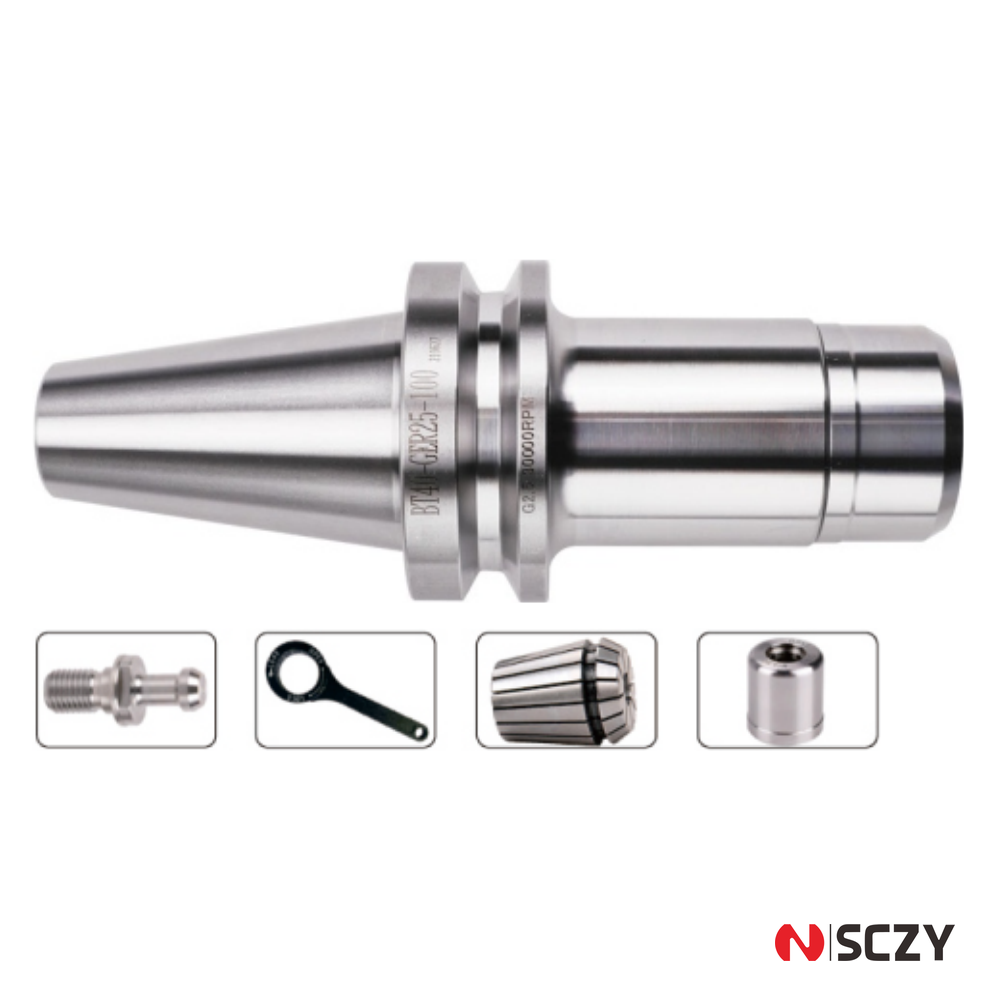
BT40 vs BBT40 vs HSK-A63
Dual contact is one answer to a stiffness problem, not the only one. The table below puts the three interfaces most often compared on 40-taper-class machines side by side.
| Characteristic | BT40 (taper only) | BBT40 dual contact | HSK-A63 |
|---|---|---|---|
| Taper | 7:24 self-releasing | 7:24 self-releasing | 1:10 hollow shank (DIN 69893) |
| Contact surfaces | Taper only | Taper + flange face | Taper + flange face by design |
| Radial stiffness at long gauge length | Baseline | Noticeably higher | Highest of the three |
| Axial repeatability | Good | Better (hard flange stop) | Better |
| Typical speed class | Up to roughly 8,000-12,000 rpm | Roughly 15,000-20,000 rpm when balanced | 20,000 rpm and above |
| Spindle requirement | Any BT40 spindle | Dual-contact-capable spindle + matched pull stud | HSK spindle only |
| Retrofit to an existing BT40 machine | Not applicable | Possible, spindle face must be verified | Not possible without a new spindle |
| Holder cost (relative) | 1.0 | 1.3-1.8 | 1.6-2.2 plus spindle cost |
| Best fit | General milling, mixed legacy fleet | Long-reach milling, hard materials, existing BT40 machines | New high-speed machines, small tools, near-net finishing |
Read the table as a decision aid, not a ranking. HSK-A63 wins on stiffness and speed but needs a different spindle, pull stud system and tooling inventory. BBT40 buys most of the axial and bending benefit while keeping your existing 40-taper magazine, presetter and operator habits.
Where Dual Contact Earns Its Price
Long-reach and small-diameter tools
Stiffness loss scales badly with length and with the fourth power of diameter. A 6 mm end mill in a holder 120 mm off the spindle nose is exactly where dual contact shows up in the chips: less chatter, cleaner walls, and a tool that survives its full life instead of being pulled early.
Hard materials and heavy radial cuts
Cutting hardened steel, Inconel or a deep slot in stainless, the limiting factor is often the holder interface rather than the insert grade. Dual contact lets you keep the same cutter and take a heavier pass, or keep the same pass and stop fighting the finish.
High-speed finishing where balance matters
Above roughly 12,000 rpm the interface has to be concentric and balanced, not just clamped. A dual contact holder balanced to G2.5 at your top spindle speed, kept clean and inspected regularly, is a credible route to high-speed finishing on a BT40 platform.
Where Dual Contact Does Not Pay
- Worn spindles. If the spindle face or taper is damaged, holders will not fix it.
- Short, stiff setups. A face mill 20 mm from the spindle nose is not interface-limited. You will not feel the difference.
- Dirty shops. Holders blown off with an oily airline turn the flange into a chip trap.
- Low-speed roughing on soft material. Spend the money on fixtures or cutters instead.
- Unverified pull studs. Buy holders without matching studs and you inherit a problem you cannot see.
Speed, Balance and Runout Limits
Dual contact raises stiffness; it does not raise the balance grade of the assembly. Treat holder, nut, collet and cutter as one rotating mass and specify balance to ISO 21940 G2.5 at your maximum spindle speed. In practice:
- Keep the collet nut clean and torqued to the holder maker’s figure; a galled nut thread shifts both runout and balance.
- Check TIR at the cutter shank, not the holder body, and again after a few hours of cutting.
- Retire holders showing fretting, flange fretting corrosion or taper scoring. Regrinding a taper changes the flange relationship, so a reground dual contact holder must be re-qualified or replaced.
An Inspection Routine That Keeps It Working
Blue check on the flange
Once a quarter, and after any crash, apply layout blue to a clean holder flange, load it, clamp it and remove it. You want an even ring of contact across the full annulus. Contact only on the outer edge, or a broken ring, means the spindle face or holder flange is out of flat.
Drawbar force and stud torque
Measure drawbar force at the recommended interval. Clamping force decays with spring fatigue and with worn gripper fingers, and a dual contact interface depends on that force to keep both surfaces seated. Check pull stud torque at the same time; a stud that has backed off changes the whole geometry.
Cleanliness discipline
Wipe the taper and the flange before every load. Keep holders in a rack or protected crib, cap unused holders, and never let one sit flange-down on a machine table. Most holder problems reported on the floor are cleanliness problems with a delay.
Buying Checklist for a BBT40 Conversion
- Confirm the spindle is dual-contact capable, or budget for face rework.
- Buy pull studs to the machine builder’s drawing, not generic BT40 studs.
- Start with the tools that actually limit you: long-reach, small-diameter, hard-material jobs.
- Order holders with the balance grade and speed rating printed on the body, and keep the certificates.
- Buy protective caps and a proper rack at the same time; the flange is now a precision surface.
- Re-preset every tool after the change and tighten first-article inspection for a week.
The Bottom Line
A BBT40 dual contact tool holder is neither a universal upgrade nor snake oil. It is a specific fix for a specific problem: an interface that flexes, frets and drifts when the load path gets long or the cut gets hard. If your bottlenecks are chatter at long gauge lengths, finish on hard materials, or Z-repeatability across tool changes, dual contact on an existing BT40 platform is one of the cheapest stiffness gains available, provided the spindle face, pull studs and storage discipline meet the same standard.
If you are weighing a conversion and want a second opinion on which holder styles, pull studs and balance grades fit your machines, send us your spindle details and the jobs giving you trouble. We will come back with a matched shortlist rather than a catalogue dump.
Talk to our tooling engineers: https://www.sczymfg.com/#quote-form



