
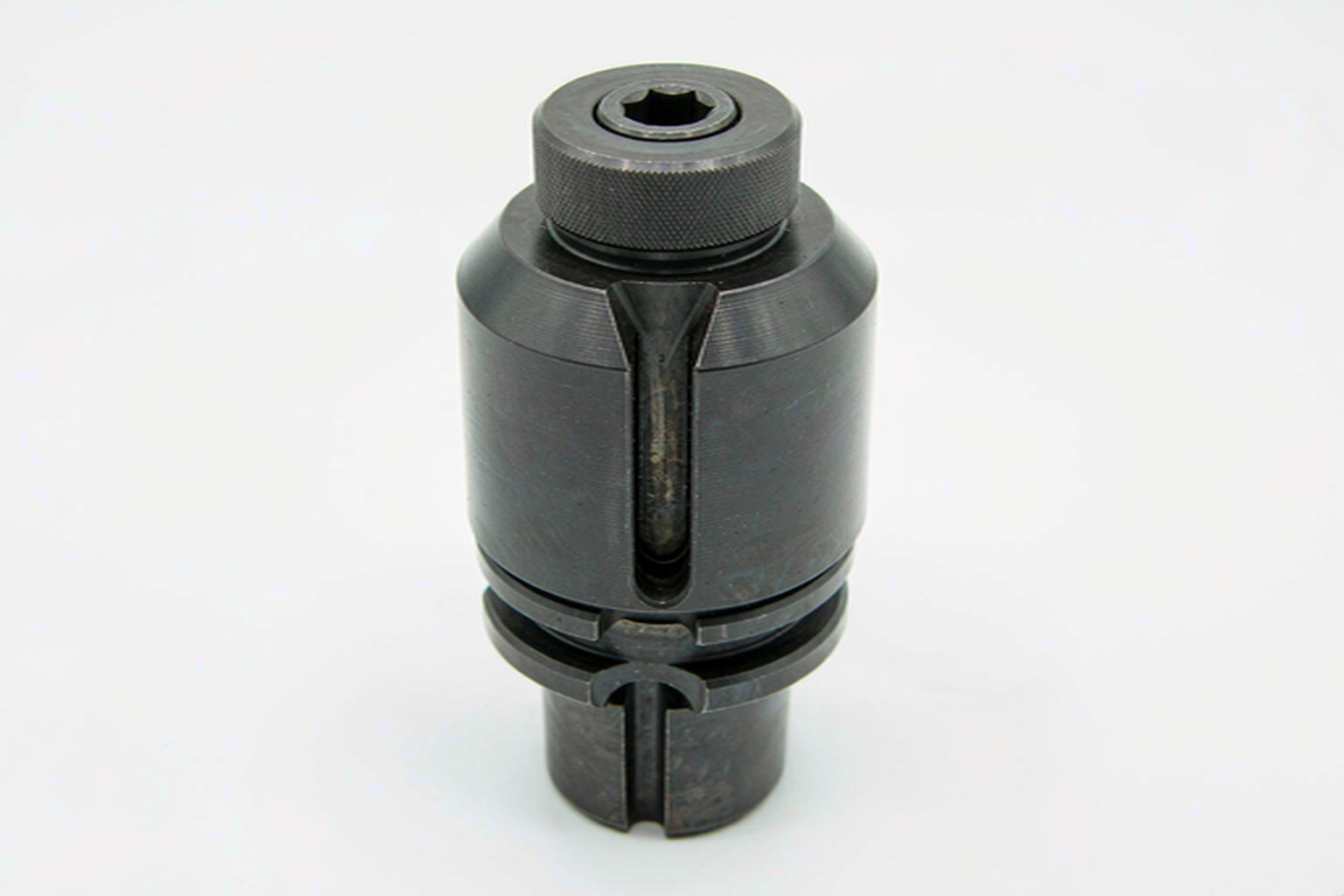
When a roughing end mill starts chattering halfway through a deep pocket, most shops blame the insert, the speeds and feeds, or the machine. Very often the real problem is upstream of all three: the tool is being held in an ER collet chuck that was never designed for that much side load. A power milling chuck exists precisely for this job — heavy, aggressive roughing where clamping force and rigidity matter more than ten-thousandth runout numbers.
This guide explains what a power milling chuck is, how it differs mechanically from the ER collet chucks most shops already own, and how to decide when the upgrade actually pays for itself. We will keep it practical: forces, numbers, and selection criteria you can check against a supplier datasheet before you order.
What a Power Milling Chuck Actually Is
A power milling chuck (sometimes called a heavy-duty milling chuck or power chuck) is a tool holder with a thick, slit cylindrical clamping bore. Instead of gripping the tool through a separate collet, the chuck body itself is slotted and tapered on the inside. When you tighten the large clamping nut, the slit segments collapse evenly around the shank and lock it with a large contact area — typically gripping 60–100% of the inserted shank length depending on the model.
The clamping mechanism in plain terms
Think of the difference between a hand squeezing a pencil with five fingertips (an ER collet) versus a full palm wrapping it (a power milling chuck). The collet contacts the shank at a few narrow bands; the power chuck wraps the entire shank circumference. That is why measured clamping force on a Ø16 mm roughing end mill can be two to four times higher than in an ER32 collet chuck of the same taper size.
Most designs add locking keys or pin holes that engage flats or a pilot on the tool shank to prevent pull-out under extreme axial loads, and the clamping nut uses a fine-pitch thread so you reach full clamping force without excessive wrench torque.
Power Milling Chuck vs ER Collet Chuck: Where the Difference Shows Up
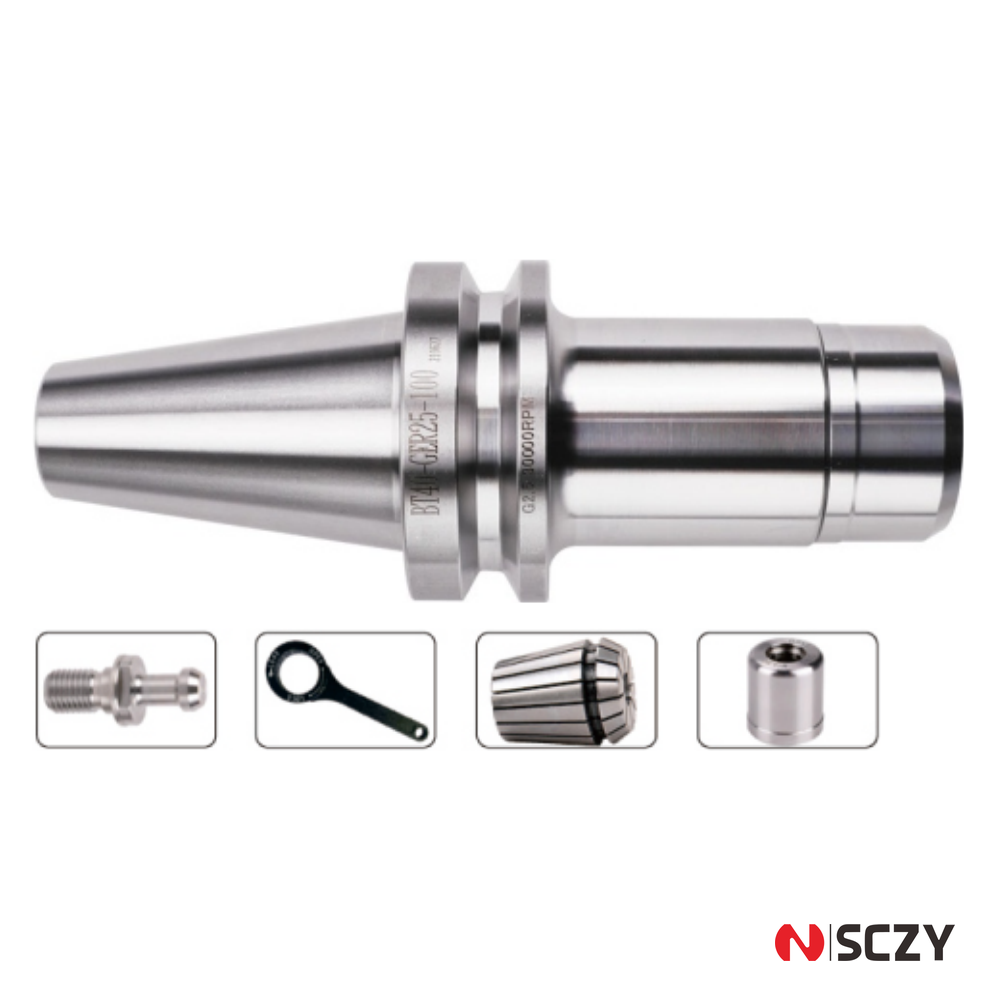
The ER collet chuck above is the workhorse of most CNC tool cabinets: compact, cheap, and available in every taper size. But it makes trade-offs that matter under heavy roughing. Here is how the two holder families compare on the parameters that drive buying decisions:
| Criterion | ER Collet Chuck | Power Milling Chuck | Side-Lock (Weldon) Holder |
|---|---|---|---|
| Typical TIR (runout) | 0.003–0.010 mm (collet dependent) | 0.005–0.015 mm | 0.010–0.025 mm (screw dependent) |
| Clamping force, Ø16 mm shank | Baseline | 2–4× baseline | High axially, point contact radially |
| Grip contact area | Narrow bands via collet | Full shank wrap, slotted bore | One set screw on flat |
| Pull-out resistance | Moderate; collet can creep | Very high with locking keys | High (positive mechanical stop) |
| Tool shank tolerance | Each collet covers a range (e.g. 6–16 mm ER32) | One bore size per tool diameter | One bore size per tool diameter |
| Rigidity under side load | Moderate | Highest of the three | Moderate-high |
| Cost per holder | Low | Medium-high | Low-medium |
| Best use | Drills, reamers, light milling, tooling variety | Heavy roughing, long-reach shoulder milling, high-torque cuts | Standard end mills, budget-heavy milling |
Reading the table honestly
Notice that the power milling chuck does not win on runout — a good ER collet chuck with an AA-grade collet will beat it there. You buy a power chuck for stiffness and grip, not for finishing tolerance. If your finishing pass is chattering, the fix is usually runout and balance, not more clamping force. If your roughing pass is chattering and pulling tools, clamping force and grip area are exactly the right levers.
Why Clamping Force Matters So Much in Roughing
Heavy roughing generates two failure modes that light milling never sees. First, radial engagement of 50% or more multiplies the lateral force on the tool shank; a marginal grip lets the tool micro-shift in the bore, which shows up as chatter marks, size drift, and accelerated holder wear. Second, helical roughing cutters generate significant axial pull-out force. In an ER collet, repeated shock cycles can let the collet creep a few microns at a time — by the end of a shift, your Z offsets are lying to you.
A power milling chuck attacks both: the full-wrap grip resists lateral micro-movement, and locking keys or a positive mechanical engagement stop axial pull-out entirely. This is why they are standard equipment in mold steel roughing, titanium pocketing, and high-helix aluminum roughing where chip loads are extreme.
Sizing and Selection: What to Check Before You Order
1. Bore size and shank match
Power milling chucks grip one nominal diameter each — a 16 mm chuck holds a 16 mm shank, full stop. There is no “range” like an ER collet. Plan your purchase around the two or three roughing shank diameters your shop actually runs (for most BT40/CAT40 shops: 12, 16, 20, or 25 mm), rather than buying a broad set you will never use.
2. Taper size and gauge length
In BT40/CAT40 machines, a Ø25 mm power milling chuck body is already close to the spindle power limit of many VMCs — check that your machine can actually use the extra grip before buying large bores. Also compare gauge projection: a stubby power chuck adds rigidity but may not reach into pockets; extended-nose versions trade some stiffness for reach. Keep the projection as short as the part geometry allows.
3. Nut tightening procedure
Because the clamping nut does the collapsing, correct torque matters more than on an ER nut. Under-tightening leaves the grip far below spec; over-tightening distorts the slit segments and can permanently raise runout. Ask the supplier for the wrench length and tightening spec, and make the tightening step part of your tool crib procedure — same wrench, same torque, every tool change.
4. Balance and speed rating
Power milling chucks are heavier than ER chucks, which shifts the balance question. For roughing at 8,000–12,000 RPM, a G6.3 balance grade is generally enough; if you plan to run the same holder at high RPM, look for factory-balanced versions (G2.5) and check the stated maximum RPM on the datasheet, not just the taper standard.
When NOT to Buy a Power Milling Chuck
Honest selection guidance means knowing where the money is wasted:
- Finishing and semi-finishing passes: runout and balance dominate here. A precision collet chuck or shrink-fit holder is the better tool.
- Tool variety on a tight budget: if your shop runs drills, taps, and end mills interchangeably, ER collet chucks cover far more ground per dollar.
- Small-diameter tools: below about 10 mm shank, the power chuck’s stiffness advantage rarely pays for its extra cost and weight.
- Machines with limited spindle power: if the spindle stalls before the tool holder becomes the bottleneck, the upgrade changes nothing.
A Practical Buying Checklist
- Measured TIR at the tool tip documented by the supplier (ask for a test report, not a catalogue claim)
- Clamping bore size matches your roughing shank diameters exactly
- Locking key or anti-pull-out mechanism included for helical roughing tools
- Stated nut tightening spec, and a wrench that enforces it
- Balance grade and max RPM consistent with your machine’s roughing speeds
- Surface-treated bore (anti-corrosion and low-friction coating) for long-term grip consistency
- Batch consistency: order your two or three roughing sizes together so runout and length offsets stay predictable
Conclusion: Match the Holder to the Cut
The holder is the quiet link between your spindle and your cutting edge, and heavy roughing is the one job where an ER collet chuck is genuinely outclassed. A power milling chuck delivers full-shank grip, anti-pull-out security, and the stiffness that keeps deep roughing passes stable shift after shift. Buy it deliberately — one bore per real roughing diameter, correct nut procedure, balance grade matched to your RPM — and it will pay for itself in inserts, cycle time, and fewer scrapped pockets.
If you want a second opinion on your roughing tooling setup — bore sizing for your shank diameters, BT40/CAT40 options, or a quote on a small trial order of power milling chucks — contact the SCZY team. We supply CNC tool holders, workholding, and cutting tools to shops worldwide and can match a holder set to your actual cutting data.



