
TL;DR
- Spindle speeds that were “high-performance” two years ago are now catalog standard: 15,000 RPM BT40 mechanical spindles and 18,000 RPM HSK-A63 motorized spindles were shown as production hardware at CCMT 2026 in Shanghai, and direct-drive milling spindles from Taiwanese builders now reach 24,000 RPM.
- China’s machine tool industry posted RMB 530.9 billion in revenue for H1 2026 (+7.6% YoY), with metal-cutting machines up 15.6% and new orders up 20.5% — driven by AI liquid-cooling plates, humanoid robot components, and energy storage structures, not traditional automotive alone.
- For buyers, the practical consequence is simple: tool holders that were “good enough” at 10,000 RPM get exposed above 15,000 RPM. Balancing grade, runout spec, and interface standard now decide whether the new spindle speed is usable or just a number on the datasheet.
Most “industry news” articles stop at the announcement. This one doesn’t — because every one of these shifts lands on the same bench: the tool holder. Below is what actually changed in 2026, and what each change means the next time you order tooling.
1. Spindle speeds moved — and the tool holder is now the bottleneck
The clearest signal of the year came from CCMT 2026 (the 14th China CNC Machine Tool Fair, Shanghai, April 2026), where several Chinese machine builders showed in-house spindles as standard production hardware rather than prototypes. The numbers that matter for tooling:
| Spindle (shown at CCMT 2026) | Type | Max speed | What it implies for tooling |
|---|---|---|---|
| BT40 | Mechanical, ceramic-ball bearings | 15,000 RPM | BT40 holders need balancing and taper quality rated for 15k, not 10k |
| HSK-A63 | Motorized, oil-air lubrication | 18,000 RPM | 5-axis machining centers; flange-face registration becomes decisive |
| BT50 | Motorized | Heavy cutting | 600 N·m peak torque; side-lock and milling holders take the load |
| Direct-drive milling (Taiwan builders) | Motorized | up to 24,000 RPM | BT30 / HSK-A63 / BBT40 ecosystems |
| High-speed motorized (European builders) | Motorized | up to 75,000 RPM | HSK-E/F territory; micro-tooling only |
Two years ago, a 15,000 RPM BT40 spindle was a premium option you specified deliberately. In 2026 it is becoming the default mid-range configuration, and industry commentary at the fair described domestically produced spindles as having reached “scaled substitution” — meaning more machines, at more price points, ship with these speeds.
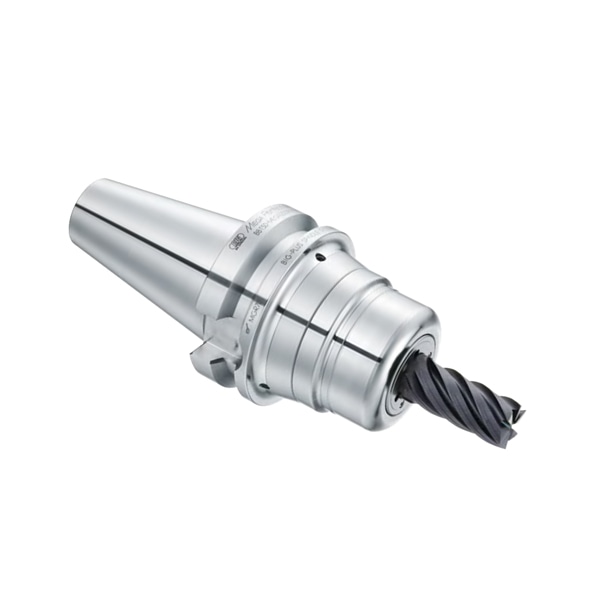
What this means for your tool holder order: a holder that runs fine at 8,000–10,000 RPM can become the limiting factor at 15,000. The three specs to check are:
- Balancing grade. Ask whether the holder is supplied balanced to G2.5 at your actual operating speed — not just “balanced” as a marketing word. Unbalance force grows with the square of RPM, which is why a holder acceptable at 10k can shake a spindle at 15k.
- Taper accuracy and contact. At higher speeds, BT-type holders climb into the spindle as the bore expands. Holders ground to a tighter taper tolerance keep the Z-position shift predictable.
- Runout spec, measured not claimed. Under 5 µm at 3× diameter is a reasonable bar for milling holders; premium ER and heat-shrink systems sit well under that.
If you want the full physics of why speeds change the comparison, we covered it in detail in our guide to BT40 vs HSK-A63 tool holders — the short version: above roughly 12,000–15,000 RPM, the interface, not the spindle, usually decides what you can actually run.
2. The demand side changed: why order books are full
The China Machine Tool & Tool Builders’ Association reported strong H1 2026 numbers for the industry:
| Indicator (H1 2026, YoY) | Change |
|---|---|
| Industry revenue | RMB 530.9 bn, +7.6% |
| Metal-cutting machine revenue | +15.6% |
| New orders | +20.5% |
| Order backlog | +19.1% |
| Total profit | +110.8% |
The interesting part is who is buying. The growth is not a simple automotive recovery. Industry reporting points to four new demand engines, and each one pushes tooling requirements in a specific direction:
AI liquid-cooling plates
Dense micro-channels machined in aluminum, with flatness and sealing-surface finish requirements at the micron level. This is high-speed aluminum milling — exactly the workload where ER collets and heat-shrink holders with low runout pay for themselves in surface finish and cycle time.
Humanoid robot components
Planetary roller screws with micron-class thread accuracy and joint parts where vibration control is critical. Thread whirling and precision turning push demand toward rigid, repeatable holder systems.
Energy storage structures
High-volume battery structural parts with tight takt times — machines run long shifts without interruption, which puts a premium on holders that hold their accuracy over thousands of clamp cycles.
General precision parts
The steady base that never went away.
The pattern across all four: buyers are no longer asking “is there a holder that fits?” but “will this holder still be accurate after 200 hours of continuous high-speed running?” That question has a different answer depending on collet type, balancing, and taper quality — and it is worth asking before the PO, not after the first scrap bin.
3. Automation reached the tool crib
Two product announcements from the September/October 2026 trade press show where the toolroom itself is heading:
- Automated insert handling with AI wear inspection. Zoller’s Micbox system now automates the full indexable-insert cycle on milling tools — identification via RFID, mounting, indexing, flipping, and even replacing fastening screws after a defined service life. An optional AI-supported measuring function inspects every cutting edge and decides whether it stays in service, moves to the next edge, or gets replaced. The point for buyers: when your tool crib runs semi-autonomously, the holder’s repeatability becomes a system spec, not a per-part spec.
- Press-fit toolholding as a vibration answer. Rego-Fix continued promoting its PowRgrip system at BI-MU 2026 in Italy — a taper-to-taper press-fit design with no heat and no hydraulics, toolsetting in under 10 seconds, and a vibration-damping geometry. It is a reminder that collet choice is ultimately a vibration-management decision.
For a sourcing or procurement manager, the takeaway is straightforward: shops investing in automation are specifying tooling with documented, repeatable specs — because a robot cannot compensate for a holder that drifts. That is shifting purchasing conversations from price-per-piece toward certificate-level consistency.
4. The sourcing map: more supply, more need for specification discipline
The supply side also shifted this year. Chinese tool holder makers were visibly active across the autumn exhibition circuit — full BT/HSK/BBT, hydraulic and spinning holder ranges plus ER collets were shown at MAKTEK Eurasia in Istanbul (September–October 2026, with distributors from Turkey, Eastern Europe and the Middle East reportedly signing regional agency intentions), and workholding and collet suppliers were meeting overseas buyers at the October Canton Fair sessions.
Meanwhile, 2026 sourcing guidance for smart machining cells already treats HSK63A as the default for 5-axis cells, HSK100 for heavy milling, and BT40 for cost-sensitive 3-axis VMCs — interface choice is becoming a procurement standard rather than a per-machine decision.
More supply is good for buyers’ leverage. But it also means the quality spread between suppliers is wider than ever, and the difference shows up in exactly the specs that matter at high speed. Before committing to a holder supplier, get answers to four questions:
| # | Ask the supplier | Why it matters in 2026 |
|---|---|---|
| 1 | What is the guaranteed runout, measured at what projection? | Determines tool life and finish at every speed |
| 2 | Is balancing to G2.5 included, at which RPM? | The spec that decides whether 15,000 RPM is usable |
| 3 | What steel and heat treatment (case depth, hardness)? | Accuracy retention over clamp cycles and years |
| 4 | Are taper and flange inspected per-piece with reports? | Interchangeability across the spindle fleet |
A supplier who answers all four with documents, not adjectives, is worth a slightly higher unit price. One who dodges them is costing you spindle bearings.
5. One date for the calendar: December in Jakarta
For buyers and sourcing teams in Southeast Asia, the Machine Tool Indonesia / Manufacturing Indonesia / Industrial Automation Indonesia co-located shows run 2–5 December 2026 at JIEXPO Kemayoran, Jakarta. Given how much of the year’s tooling news is about matching holders to faster spindles, it is a practical opportunity to compare holder samples from multiple suppliers side by side — and to ask the four questions above in person.
Our own coverage of the region’s manufacturing clusters continues: see our buyer’s guide to Penang’s semiconductor supply chain for how regional demand translates into tooling requirements.
6. How to act on this before your next PO
News is only useful if it changes a decision. Here is the sequence we recommend to buyers who are about to spend on tooling against a faster spindle:
- Confirm your real maximum speed. Not the spindle’s catalog ceiling — the highest RPM you actually run in production, with the tool you actually use. Balancing is specified at that number.
- Audit the holders you already own. Any holder bought for a 10,000 RPM machine is a candidate for retirement if the new spindle runs 15,000. A quick check: runout at 3× diameter, then a balancing check at operating speed.
- Standardise by interface, not by brand. If you run both BT40 and HSK-A63 machines, keep a single spec sheet per interface so holders stay interchangeable across the fleet. Mixed specs are how shops end up with two pre-setting routines and duplicated tooling.
- Buy certificates with the hardware. Runout and balancing documents per lot cost nothing extra from a serious supplier, and they are the only way to hold a supplier to a spec six months later.
One cost note worth repeating: at 2026 supply levels, balanced BT40 and HSK63 end-mill holders from established Chinese suppliers sit in a broad band, and the spread between the cheapest and the best is usually smaller than one scrapped batch of parts. Buy the certificate, not the discount.
7. FAQ
Q1: Is BT40 still a good choice in 2026, or should every shop move to HSK?
A1: BT40 remains the right choice for cost-sensitive 3-axis work up to roughly 12,000 RPM — it is still the standard interface on new mid-range VMCs. Move to HSK when you run sustained speeds above ~15,000 RPM or need the rigidity for 5-axis simultaneous work.
Q2: What balancing grade should I ask for on a 15,000 RPM BT40 holder?
A2: G2.5 at the maximum operating speed is the accepted baseline for high-speed holders. If a supplier only states “balanced” without a grade and speed, assume it was done at a lower speed and will not hold at 15k.
Q3: Are Chinese-made tool holders acceptable for high-speed work now?
A3: The spread has widened, not closed. Top-tier Chinese holders — precision-ground, per-piece inspected, G2.5 balanced — are running in production worldwide. The qualification questions in section 4 are how you separate them from the rest.
Q4: Why is ER collet runout suddenly a bigger topic?
A4: Because the new demand drivers — liquid-cooling plates, robot parts — are finishing-heavy aluminum and precision work where 10 µm of runout visibly costs tool life and surface finish. At high speed, every micron of runout is amplified.
Q5: What is the difference between HSK-A and HSK-E for the new 18,000 RPM spindles?
A5: HSK-A63 is the general-purpose hollow-shank interface with torque-transmitting keys, common on 5-axis machining centers. HSK-E/F are balanced symmetrically with smaller gripping diameters, intended for very high RPM and lighter cutting — typically above 20,000–30,000 RPM.
Q6: Where can I compare tool holder suppliers before year-end?
A6: Machine Tool Indonesia in Jakarta (2–5 December 2026) is the main regional event for SEA buyers; for direct technical comparison, request runout and balancing certificates from shortlisted suppliers and compare them against the checklist in section 4.
Written by the SCZY tooling team — a technical sourcing partner based in Dongguan, China, supplying precision tool holders, ER collets, workholding and magnetic chucks from a vetted factory network, with consolidated shipment and per-piece inspection reports. Questions about matching holders to your new spindle spec? Ask us for the spec sheet before you order.
GET A QUOTE
Looking to upgrade your CNC tooling setup?
Explore our product range or send us your requirements. Our team will be glad to review your inquiry.



