
5-Axis Vise Selection: Low-Profile Clamping, Jaw Options and Zero-Point Workholding
If you have ever watched a five-axis machine crash a standard six-inch vise, you already know the core problem with 5-axis workholding: the vise itself gets in the way. A conventional machine vise was designed for a vertical spindle coming straight down. On a five-axis machine the part rotates and tilts, and suddenly every millimeter of vise height and every exposed jaw screw becomes a potential collision. Choosing the right 5-axis vise therefore defines what geometry you can actually reach, how many setups you need, and how confidently you can push feed rates.
This guide covers what separates a true 5-axis vise from a standard machine vise, which jaw options matter for five-sided machining, and how zero-point clamping ties the system together for lights-out production.
Why a Standard Vise Fails on a 5-Axis Machine
A standard vise fails on a five-axis machine for three reasons, and none of them are about clamping force.
First, height. A typical 6-inch machinist vise stands 100 to 150 mm tall above its mounting surface. On a trunnion-style 5-axis machine the envelope above the table is limited, and a tall vise forces the part so far up that you lose Z travel or run the A-axis into its rotation limits just to clear the vise body. Every degree of tilt you spend avoiding the vise is a degree you cannot spend machining the part.
Second, collision geometry. Standard vise bodies have raised rails, screws sticking out of the sides, and handle bosses that sit exactly where a tilted cutter or a 30-degree head wants to pass. On a vertical mill you never notice these features. On a five-axis machine, the simulation software flags them constantly, and operators slow down or redesign fixtures around them.
Third, undercut access. Five-axis parts usually need machining on five faces, and often the sixth. A vise that grips only the bottom edges of the part blocks both side access and the underside. You end up flipping the part for a second op, which defeats the entire reason you bought a five-axis machine: consolidating operations.
What Makes a 5-Axis Vise Different
A purpose-built 5-axis vise solves those three problems with a few deliberate design choices. Understanding them helps you compare brands on features that actually matter rather than catalog adjectives.
Low-Profile Body and Minimal Jaw Height
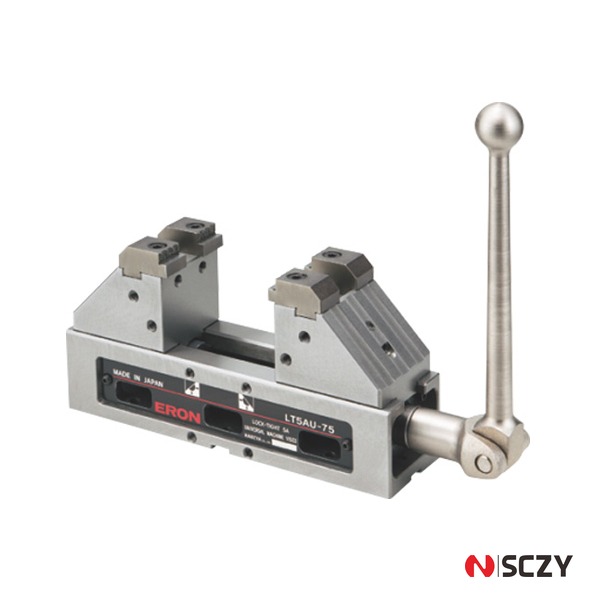
The defining feature is a body that stays as low and narrow as possible. Good five-axis vises keep the movable jaw completely below the fixed jaw’s clamping surface, and the overall height above the table often runs 40 to 70 mm depending on size. The LT5AU-series vise shown above is a typical example: a compact twin-jaw body, a pull-down clamping mechanism, and hardened jaw plates that sit nearly flush with the top of the body. Lower jaw height means more usable motion for the A and C axes, and a shorter grip length on the part — which matters because many 5-axis parts are plates or thin housings with limited gripping area.
One often-overlooked detail is the clamping mechanism itself. On better 5-axis vises, the screw or linkage is fully recessed inside the body, so nothing but the jaws and the part stick up above the table. When you evaluate a vise, rotate your CAM simulation through the full A-axis range at several C positions and check what appears in the swept volume.
Pull-Down Action and Clamping Force
Many five-axis vises use a pull-down jaw design: the movable jaw is pulled downward against the bed as it clamps inward, so the part is pressed onto parallels rather than lifted. This matters more than raw tonnage. A vise that lifts the part during clamping can pull a shallow plate off its seating, and on a five-axis machine you will not see the gap until the first aggressive side-milling pass moves the workpiece. Ask for the rated clamping force and, more importantly, confirm whether the jaw travels with a downward component. For thin-wall aerospace brackets, that pull-down action plus a moderate, repeatable force is usually better than maximum tonnage.
Rigidity Where It Counts
Five-axis machining is frequently aggressive in side milling and swarf cutting, where cutter loads act sideways on the part. The vise body should be hardened steel, the jaw ways ground, and the clamping screw supported on both ends where possible. Also check repeatability — a good 5-axis vise re-clamps a part within a few hundredths of a millimeter, so a second op after a pallet change needs no re-indicating.
5-Axis Vise vs Standard Vise vs Zero-Point System
The table below compares the three workholding approaches shops typically weigh when they add five-axis capacity. None is “best” — they solve different production problems.
| Criteria | Standard Machine Vise | Purpose-Built 5-Axis Vise | Zero-Point Clamping System |
|---|---|---|---|
| Height above table | High (100–150 mm typical) | Low (40–70 mm typical) | Very low pallet stack, part on pallet |
| Collision exposure | Exposed screws, rails, handle | Recessed mechanism, flush jaws | Minimal — pallet is a flat plate |
| Side and undercut access | Poor | Good on sides, moderate below | Excellent, all sides plus bottom with risers |
| Setup change time | Minutes, re-indicate part | Minutes, repeatable to ~0.02 mm | Seconds, repeatable to ~0.005 mm |
| Cost per station | Low | Moderate | Higher (chucks plus dedicated pallets) |
| Best fit | General 3-axis work | Single-part and small-batch 5-axis machining | Recurring batches, pallet pools, lights-out |
For a shop running a handful of five-axis jobs with frequent changeovers, a quality low-profile vise on each trunnion side is usually the sweet spot. As batch frequency grows and you want to swap complete jobs in seconds, adding a zero-point locking system becomes the better investment.
Jaw Options: Getting a Grip on Awkward Parts
The vise body is only half the system. Jaws determine what shapes you can actually hold, and on five-axis work the jaw program matters as much as the vise itself.
Machined Soft Jaws for Profiled Parts
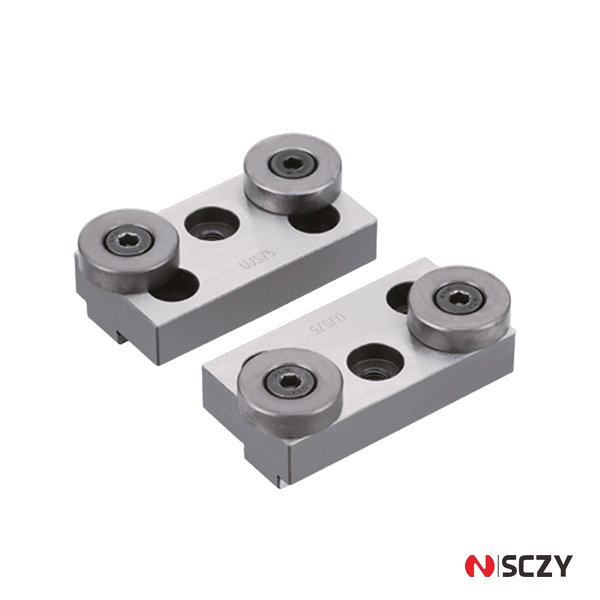
Aluminum or mild-steel soft jaws can be bored or pocketed in-situ to match the part profile exactly. On a five-axis vise, machine the soft jaws with the same datum scheme you will use on the part, and you gain two benefits: full clamping contact on irregular profiles, and a permanent datum reference so the part returns to position after any handling. For brackets, housings, and any casting with draft, machined soft jaws are the default answer.
Serrated Hard Jaws for Rectangular Stock
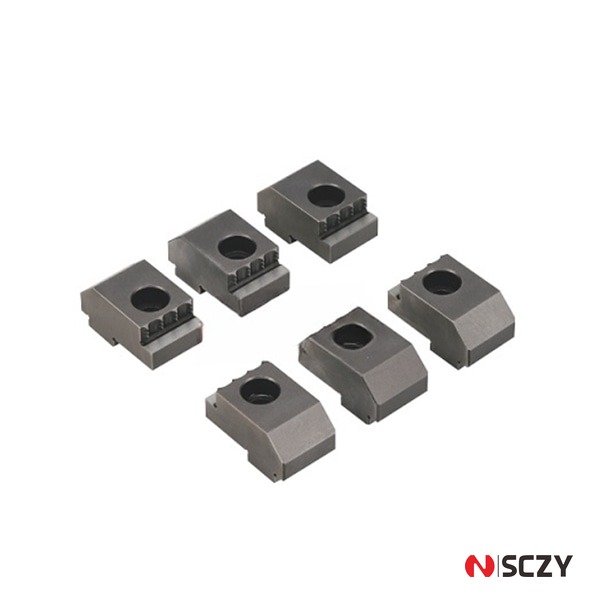
For raw rectangular stock and second operations where you are machining away most of the material, serrated hardened jaw plates bite into the surface and resist side loads with less clamping pressure. The replaceable serrated inserts used on low-profile 5-axis vises are inexpensive consumables: you swap them in minutes and regrind or replace them as they wear, instead of scrapping a full jaw set.
Specialty Jaw Geometry
Most vise manufacturers also offer dovetail jaw inserts for thin-wall parts gripped on a dovetail band machined into the stock, stepped jaws for holding plates near the top edge, and V-jaws for round stock. If your parts are thin-walled titanium or Inconel, dovetail workholding deserves a serious look — the gripping force is distributed around a band rather than concentrated on two flat faces, which reduces distortion on the first heavy cut.
Zero-Point Clamping: The Multiplier on Top of the Vise
A 5-axis vise solves collision and access. A zero-point clamping system solves changeover time. The concept is simple: a repeatably located pallet — located by tapered rollers or spherical seating pins and locked by pulled-in balls or pins — mounts under your vise or directly carries the part. You set up the job once on a bench, then swap between jobs on the machine in seconds with sub-hundredth repeatability. No indicating, no edge finding, no re-touching off.
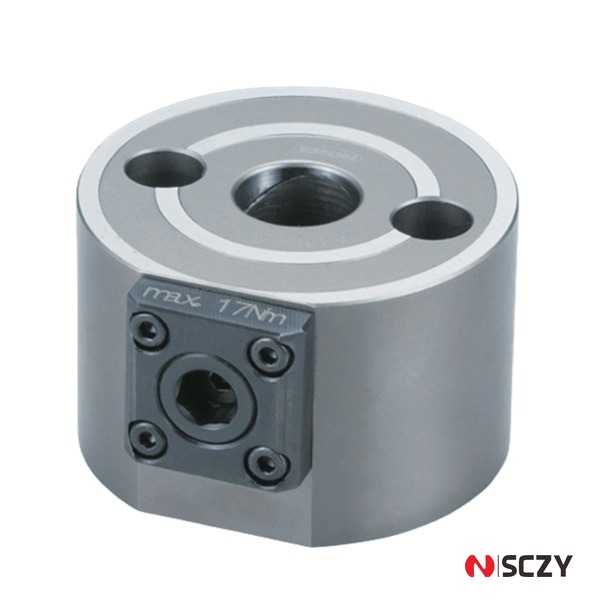
Compact manual-pull zero-point modules of the type shown above are small enough to install on a five-axis platen or trunnion face — exactly where changeover pain is worst, because every five-axis setup touches multiple datums that are slow and error-prone to re-establish manually. Typical modular systems in this class pull the pallet down with a manual screw torque of roughly 17 Nm — a few seconds of hand effort for a lock rigid enough for full five-axis cutting loads.
The practical pattern for growing shops: keep a low-profile vise bolted to a zero-point pallet, and build duplicate pallets for each job. Swapping is a 30-second manual operation, so lights-out running stops being blocked by setup labor.
Sizing and Layout Mistakes That Cost Real Money
A few recurring mistakes are worth designing out before the vise arrives:
- Ignoring the jaw-opening envelope at full A rotation. Model the open jaw positions, not just the clamped one — a vise that fits closed may hit the trunnion when opened wide.
- Exceeding the grip-length-to-height ratio. If the part stands tall above shallow jaws, side loads convert into lift. Use step jaws or add a stanchion support rather than trusting jaw friction.
- Mounting slots misaligned with the table grid. Confirm slot spacing matches your machine’s grid or trunnion pattern; adapters eat precious height.
- Forgetting chip evacuation. Chips pack under the movable jaw of a low-profile vise; choose open chip paths and plan a blow-off step in the cycle.
- Underestimating repeatability requirements. If pallet changes will be routine, verify the combined repeatability of vise plus zero-point interface, not the chuck spec alone.
A Practical Selection Checklist
Before you order, walk through this list against your actual jobs:
- List your five-axis parts by envelope and grip length; eliminate any vise whose body height forces A-axis restrictions on more than one of them.
- Check jaw-opening range against the largest part, and jaw height against your thinnest plate.
- Confirm the clamping mechanism is recessed and the jaw pulls the part down.
- Decide the jaw program: serrated for stock, machined soft jaws for profiles, dovetail for thin walls.
- If changeovers are weekly or more frequent, price the zero-point pallet route now — retrofitting later costs more.
How SCZY Supports 5-Axis Workholding
SCZY supplies low-profile 5-axis vises, serrated and soft jaw programs, zero-point locking components, and the full range of CNC workholding and tooling accessories for export customers across Asia, Europe and North America. Because we source from vetted Japanese and Taiwanese manufacturers and QC every shipment in Dongguan, we can mix brands within one project without you managing multiple suppliers — and we support mixed-size trial orders, so you can validate a jaw or pallet design on one machine before standardizing across the shop.
If you are planning a five-axis cell and want a second opinion on vise sizing, jaw selection or a zero-point layout, send us your part drawings and machine table pattern. Visit our contact page and tell us what you are cutting — our engineers will come back with a workholding proposal and a quotation within one business day.



