
If you run face mills on a machining center, the cutter body gets all the attention while the
shell mill arbor underneath it quietly decides how the whole setup performs. The arbor
carries the cutting load, sets the projection length, and holds the runout budget that your insert
edges ultimately pay for. Pick the wrong arbor type or size, and even a premium face mill will
chatter, wear inserts unevenly, and leave a rough finish. This guide walks through the common shell
mill arbor types (A, B and C styles), how to match the arbor to your cutter, and the sizing and
runout checks that separate a stable face-milling setup from a noisy one.
What a Shell Mill Arbor Actually Does
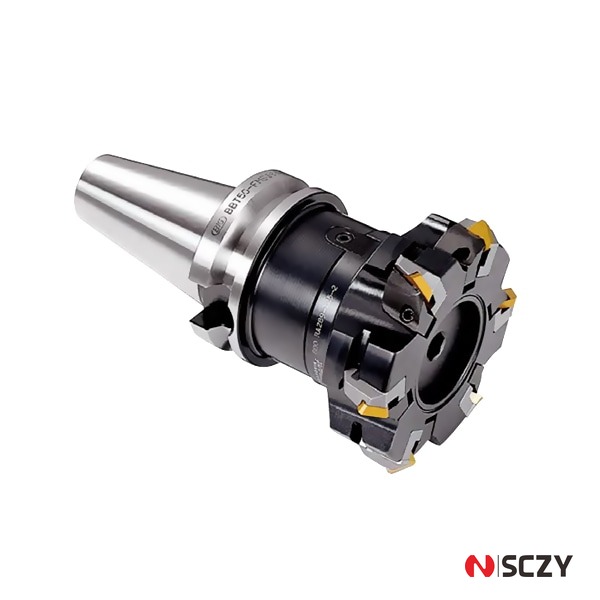
A shell mill arbor — sometimes called a face mill holder or face mill arbor — is a tapered holder
(BT, CAT, BBT or HSK) that ends in a cylindrical pilot instead of a collet or Weldon flat. The face
mill slides over the pilot, registers against a precision-ground flange face, and is clamped by a
retaining screw or drawbolt through the center of the arbor. Drive torque is transmitted through
drive keys or drive slots machined into the arbor and cutter body.
Compared with holding an end mill in a collet chuck, a shell mill arbor gives you three things:
- Shorter, stiffer projection. The cutter registers on a wide flange instead of
hanging out of a collet, so cutting forces travel a shorter path into the spindle. - Positive drive. Drive keys carry the torque instead of friction alone, which
matters for large-diameter cutters taking heavy bites. - Fast, repeatable changes. Undo one center screw, swap cutter bodies, retighten.
No re-indicating the holder.
The Common Shell Mill Arbor Types
Most suppliers catalog face mill arbors in a handful of styles, usually labeled by letters
(A, B, C and heavier-duty variants). The exact lettering differs between brands, but the mechanical
ideas behind them are consistent. Understanding the three basic constructions is enough to buy
correctly.
B-Type: Flange and Pilot Style for Full-Contact Mounting
The B-type arbor is the workhorse for medium and large indexable face mills. It has a wide
precision-ground flange, a cylindrical pilot that locates the cutter bore, and a center retaining
screw that pulls the cutter hard against the flange. Because the cutter registers over a large
diameter, the setup resists tilting loads from angled-insert face mills and high-feed cutters.
This is the style to reach for on cutters roughly Ø80–160 mm taking real metal.
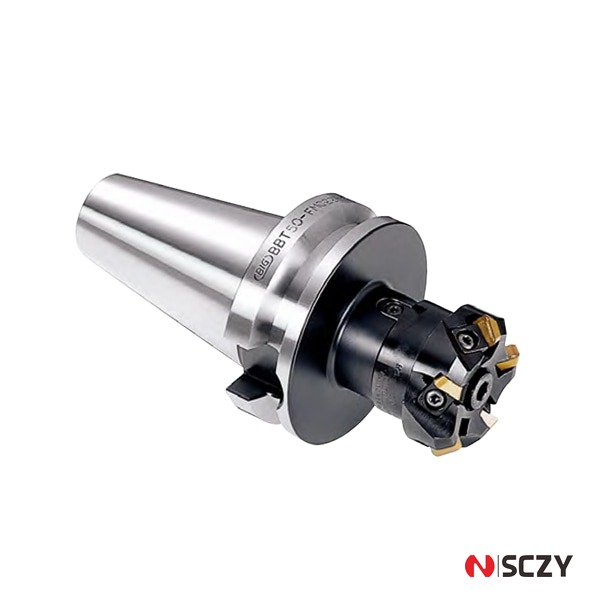
C-Type: Compact Stub Style for Small Cutters
The C-type arbor trades flange width for compactness. The pilot is shorter and the overall
projection is minimal, which keeps a small face mill or shell end mill close to the spindle nose.
That makes it the natural choice for shell end mills up to about Ø80 mm, for work in pockets and
near walls, and anywhere you need to reduce the stickout to protect the setup from chatter.
The trade-off is less flange support, so it is not the holder for aggressive heavy cuts on big
bodies.
H-Type and Long-Drawbolt Styles
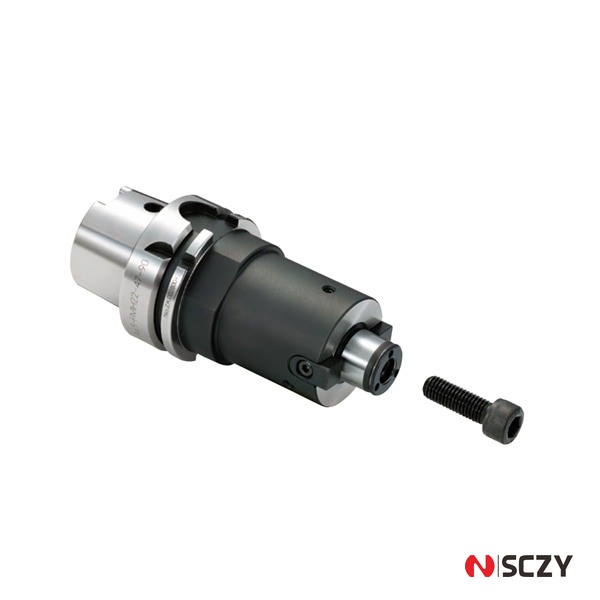
Heavier variants use a long drawbolt that threads deep into the cutter body, sometimes with a
hex-socket retaining screw at the nose. The longer thread engagement and larger screw cross-section
handle the shock loads of interrupted cuts and forged surfaces. If your cutting list includes
castings with scale or welded gates, an H-type or heavy-duty arbor is worth the small premium
over the basic style.
A-Type: The Classic Side-and-Face Cutter Arbor
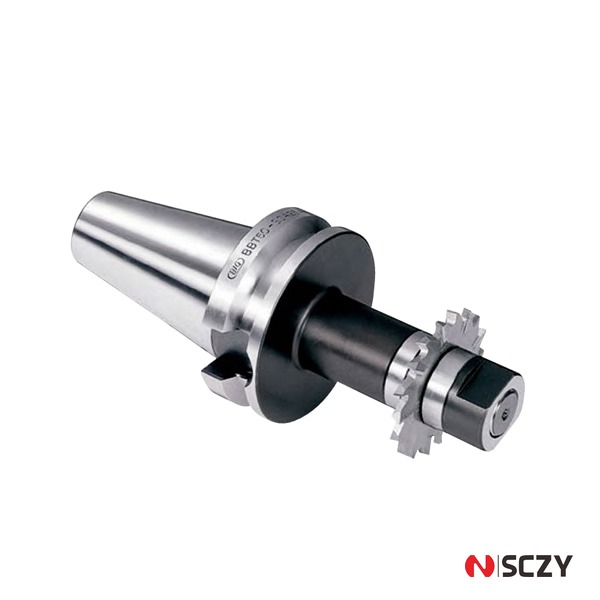
The letter A is usually reserved for the oldest concept in the family: a long, slim arbor made
for side-and-face milling cutters, slotting cutters and slitting saws. Spacers stack along the
arbor to position multiple cutters for gang milling, and the hex drive at the nose transmits torque
from a wrench or the machine spindle. Modern CNC shops mostly use these on horizontal machines,
but they remain the right answer for milling slots and flanks in one pass.
Type Comparison at a Glance
| Feature | B-Type (Flange & Pilot) | C-Type (Compact Stub) | H-Type (Heavy Duty) | A-Type (Side & Face) |
|---|---|---|---|---|
| Typical cutter | Face mills Ø80–160 mm | Shell end mills up to Ø80 mm | Large face mills, interrupted cuts | Side / slot / slitting cutters |
| Mounting | Wide flange + pilot + center screw | Short pilot + center screw | Long drawbolt, deep thread | Arbor with stacked spacers + hex drive |
| Rigidity | High | Moderate, very short projection | Highest under shock | Depends on arbor length |
| Best for | General face milling, high-feed | Close-to-wall work, small bodies | Castings, forgings, heavy stock | Slotting, gang milling, HMC |
| Watch out for | Cutter bore condition | Less flange support | Drawbolt torque discipline | Spacer stacking and cutter squareness |
Matching the Arbor to Your Face Mill
Start With the Cutter Bore
Everything begins with the mounting bore in the cutter body. Face mills come with standardized
bores — common sizes run Ø16, 22.225, 27, 32, 40, 50 and 60 mm depending on cutter diameter and
brand. The arbor pilot must match this bore exactly; there is no “close enough”. A pilot worn
below nominal leaves clearance that shows up immediately as cutter runout and uneven finish marks.
When you buy a new cutter, note the bore and order the arbor for it at the same time —
mixing brands without checking bores is the most common mix-up we see.
Check the Drive Interface
Next, confirm how the cutter is driven. Some bodies have drive slots that mate with arbor keys;
others have a bolt circle for flange mounting or rely on a fixed drive tenon. The arbor flange and
the cutter must agree on this. Forcing a slot-drive cutter onto a tenon-style arbor usually damages
the slots and permanently degrades location.
Respect the Retaining Screw
The center screw is not a generic fastener. Cutters and arbors specify a thread size, an
engagement depth and a torque value. Under-torquing lets the cutter lift microscopically on entry,
which is how insert seats and screw seats get hammered. Over-torquing stretches the screw and can
gall the threads in an aluminum cutter body. Keep the manufacturer’s torque chart taped inside the
tool crib door — typical center screws for Ø100–160 mm bodies fall in the tens of newton-meters,
but the exact value belongs to the cutter maker.
Sizing the Arbor: Projection and Gauge Length
Gauge length is the distance from the spindle gauge line to the cutter mounting face. Shorter is
almost always better. Face milling loads are heavy and often interrupted, and deflection grows
roughly with the cube of the overhang for a given cross-section — doubling the projection makes the
setup about eight times softer. Practical rules:
- Choose the shortest arbor that clears the fixture and the part shoulders.
- For deep pockets or tall shoulders, consider a shoulder-clearance arbor with a reduced neck
rather than a longer standard one. - Where the projection must be long, drop the chip load and take lighter depths instead of
pretending the rigidity is still there.
Also verify the flange does not foul the spindle nose. Some compact arbors are deliberately
short so the cutter sits nearly against the gauge face; combined with a deep cutter body, this can
interfere on small spindles. One dry assembly on the bench costs nothing and catches it.
Runout: The Spec That Decides Insert Life
Runout kills face mills quietly. The arbor itself should indicate within about 0.02 mm TIR at
the pilot when mounted in a good spindle; beyond that, each insert takes a different bite, finish
degrades into visible steps, and one or two inserts wear out long before the rest. Remember that
total cutter runout is a chain of three tolerances: the spindle taper, the arbor flange and pilot,
and the cutter body’s own bore and face. A perfect arbor cannot rescue a worn cutter bore, and a
new cutter cannot rescue a scored arbor flange.
How to Check It in Five Minutes
- Clean the spindle taper, arbor flange, pilot and cutter bore with lint-free wipes. One chip
under the flange is worth 0.05 mm of runout by itself. - Mount the arbor alone and indicate the pilot near its midpoint while slowly rotating the
spindle by hand. - Mount the cutter, then indicate the pilot again through the cutter’s center hole. If runout
jumps after adding the cutter, the problem is in the cutter body or debris, not the arbor. - Log the reading. A drifting trend over weeks usually means flange wear or a deteriorating
spindle taper, and it is cheaper to regrind or replace before the finish complaints start.
Installation and Care on the Shop Floor
Shell mill arbors are simple tools, but a few habits keep them accurate for years. Wipe the
taper before every mount and store arbors in a rack with their taper protected rather than loose
in a drawer. Inspect the pilot for scoring at every cutter change — a bright ring at the entry of
the pilot means the cutter has been rocking. Check the center screw threads; a screw that turns
hard should be replaced, not forced. And never run a shell mill without the retaining screw fully
torqued: the drive keys carry torque, but only the screw holds the cutter on the pilot.
Quick Selection Checklist
- Cutter bore Ø matched to arbor pilot — verified, not assumed.
- Drive interface agreed: keys, slots or flange bolts.
- Projection as short as the part allows; gauge length documented.
- Retaining screw size and torque value on file for each cutter.
- Mounted runout at the pilot ≤ 0.02 mm TIR, checked and logged.
- Arbor style matched to the cut: B-type for general face milling, C-type for compact work,
heavy-duty drawbolt styles for interrupted cuts, A-type for side and slot milling.
SCZY supplies shell mill arbors and face mill holders in BT, BBT, CAT and HSK tapers, matched to
all common cutter bore sizes, with accuracy-ground pilots and flanges. Not sure which arbor style
fits your cutter and cut list? Send us the cutter diameter, mounting bore and machine interface —
our engineering team will recommend the right arbor and quote a trial order. Visit our
contact page to get started.



