
Walk down any tool crib aisle and you will find at least a few drill chucks sitting in a drawer, even in shops that have gone almost fully collet-based. They survive for a simple reason: no other workholding on the spindle accepts a 1 mm pilot drill and a 13 mm screw-machine drill with the same convenience. But “convenient” is not the same as “correct”, and the difference between a well-chosen drill chuck and a bargain-bin one shows up directly in hole size, hole position and tool life. This guide covers the decisions that actually matter when you buy a drill chuck for a CNC machining center: keyed versus keyless, what the runout specification really tells you, and which shank option fits your spindle.
Why a Drill Chuck Still Earns Its Place on a CNC
Collet chucks dominate CNC tooling for good reasons: low runout, high clamping force and excellent balance. But there are jobs where a dedicated keyless drill chuck is the better answer:
- Frequent bit changes across a wide diameter range. One chuck covers roughly 0.3–13 mm; covering that range with ER collets takes five or six sizes.
- Round-shank bits without flats. Straight-shank drills, center drills and small reamers all go straight in.
- Light-duty tapping and reaming in job-shop work where rigidity demands are modest.
- Maintenance and repair work, where the operator handles dozens of odd bit sizes in one shift.
What a drill chuck is not for: heavy roughing, round tools above roughly 13 mm, or any cut where tool pull-out is catastrophic. For those, move up to a power milling chuck or a side-lock holder.
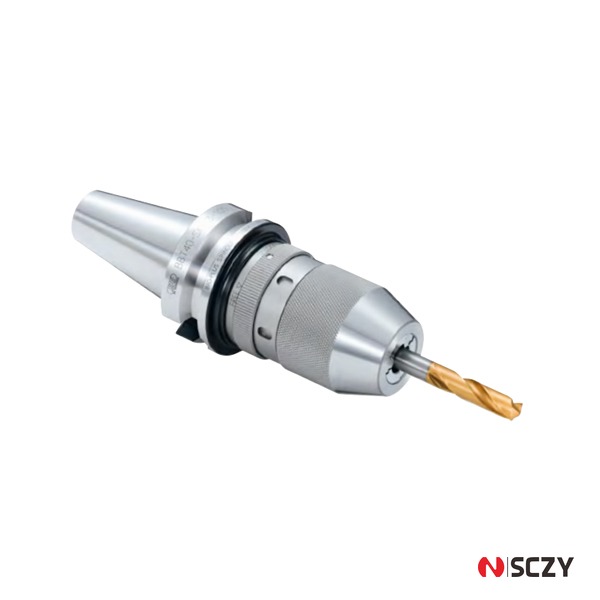
Keyed vs Keyless: Where Each Design Wins
The traditional keyed drill chuck closes its three jaws with a key that multiplies hand force. That gives it the highest torque transmission of any self-centering chuck design, which is why keyed chucks still hold large taper-shank drills on manual machines. On a CNC, though, the key is a liability: operators lose it, leave it in the chuck, and the search time per tool change adds up across a shift.
A keyless drill chuck tightens by gripping the knurled sleeve — with the spindle stopped, of course — and good designs add an integrated stop ring that bears against the spindle nose. That ring does two jobs: it stops the sleeve from spinning off during rotation, and it provides a reaction face so the operator can apply serious tightening torque without the chuck spinning on the taper. Quality keyless chucks also specify a tightening torque (often 30–60 N·m for a 13 mm model); under-tightening is the number-one cause of bit slip in production.
The newest category for CNC work is the integrated-taper keyless chuck: the chuck body and the BT or CAT taper are one machined piece, with no arbor joint in between. Compared with a chuck mounted on a JT (Jacobs taper) arbor, the integral design removes one stack-up error source, shortens the gauge length, improves balance, and typically cuts TIR roughly in half.
Runout: The Spec That Decides Hole Quality
Runout at the jaw line — usually quoted as TIR (total indicated runout) at a test pin clamped a fixed distance from the jaws — is the single most important number on a drill chuck datasheet. It governs the hole more than the drill does. At the cutting edge, runout makes one lip cut heavier than the other, so the drill pushes to one side: holes come out oversized, drift off position, and small drills under 3 mm snap at the first chirp of chatter.
Typical TIR classes you will see quoted:
- Standard industrial: 0.03–0.05 mm TIR — acceptable for clearance holes, castings and general repair work.
- Precision keyless: 0.01–0.02 mm TIR — suitable for tapped holes in aluminum and most production drilling.
- Integral-body precision: 0.005–0.01 mm TIR — the class to buy when the chuck also holds reamers and small pilot drills.
Two practical notes. First, quoted TIR is measured with a ground test pin, not a drill; a worn or bent drill adds its own error on top. Second, runout grows with debris: a single aluminum chip in a jaw groove can double the measured TIR. The chuck that measures 0.01 mm on day one measures 0.025 mm a month later if the jaws are never cleaned — which is why runout belongs in your preventive-maintenance checklist alongside taper cleaning and pull stud inspection.
Torque, Slip and Why Chucks Loosen in Cut
Bit slip has three usual causes, and only one of them is the chuck’s fault:
- Insufficient tightening torque. Hand-tight is not tight. Respect the manufacturer’s torque spec and use a wrench or the spindle-lock feature every time.
- Slick or short shanks. A bright, oil-film straight shank slips long before an as-ground one does. Degrease the shank, and for drills near the chuck’s maximum capacity, expect slip and choose a larger chuck or a different holder.
- Genuine overload. Three-jaw chucks grip with radial force only; when thrust and torque spike (say, a drill breaking through and grabbing), the jaws relax momentarily. If a job routinely slips bits at correct torque, the answer is an ER collet chuck or side-lock holder, not more muscle.
Deep-hole drilling with high-pressure coolant is another boundary: most drill chucks are not coolant-through. If the process needs internal coolant, a coolant-sealed collet setup is the better platform.
Shank and Mounting Options Compared
How the chuck attaches to the spindle decides stiffness, runout and changeover speed more than the jaws do. The three common routes:
| Attribute | Keyed chuck + JT arbor | Keyless chuck + JT arbor | Integral-taper keyless chuck |
|---|---|---|---|
| Typical TIR at test pin | 0.03–0.05 mm | 0.02–0.03 mm | 0.005–0.01 mm |
| Torque transmission | Highest (keyed jaws) | Good (torque-spec dependent) | Good, limited by jaw design |
| Gauge length / rigidity | Longest, most compliance | Long, adapter joint adds flex | Shortest, stiffest |
| Tool change speed | Slow (find the key) | Fast (sleeve + spindle lock) | Fast (sleeve + stop ring) |
| Max practical RPM | ~3,000–5,000 | ~5,000–8,000 | 10,000+ (balanced design) |
| Arbor joint errors | Yes — two stack-ups | Yes — two stack-ups | None — single machined body |
| Best for | Manual mills, repair shops | Job shops, mixed CNC work | Production drilling, reaming, pilots |
The JT arbor route is cheapest and most flexible — one chuck body swaps between machine tapers by changing arbors. The integral route costs more up front but is the only option worth specifying where hole position matters or where the chuck stays in a fixed tool pocket as a permanent “drill station”.
Capacity Selection: Bigger Chucks Do Not Hold Small Bits Better
A common procurement mistake is buying one 13 mm chuck for everything. A 13 mm chuck closes its jaws around a 2 mm drill with only the jaw tips touching; clamping force collapses and runout doubles. Match capacity to the work:
- 0.5–6.5 mm chuck for PCB-style work, pilots and small tapped holes.
- 1–10 mm chuck as the general-purpose CNC size.
- 3–13 mm chuck reserved for large screw-machine drills and chassis work.
Also check jaw stroke versus the maximum drill diameter at full insertion: shallow jaw engagement on big drills is a classic slip-and-mar scenario. If your large-diameter work is regular production, a spindle-matched holder lineup with Weldon side-lock holders for the big tools is usually cheaper than fighting slip forever.
Common Failures and Maintenance That Actually Matters
- Jaw groove contamination. Clean the jaws with a brass brush and light spindle oil weekly in aluminum or cast-iron work; chips embedded here are the main cause of “mystery runout”.
- Sleeve bearing wear. If the sleeve wobbles or the stop ring face shows galling, runout will drift. Replace rather than live with it — a chuck is the cheapest tool on the carousel.
- Rust on the taper. Store chucks capped and separated from coolant-soaked holders; a pitted BT taper destroys the whole runout chain.
- Over-torquing small chucks. Applying 13 mm-chuck force to a 6 mm chuck splits sleeves. Follow per-size torque specs.
Procurement Checklist
Before you order, put these five questions to the supplier:
- What is the guaranteed TIR at the test pin, and at what projection?
- Is the body integral with the machine taper, or mounted on a JT arbor?
- What is the specified tightening torque, and is a spindle lock or stop ring included?
- Is the design balanced for the RPM your process needs?
- What is the jaw-capacity overlap with the drills you actually run?
The Bottom Line
A drill chuck will never out-clamp a shrink-fit holder, and it does not need to. Its job is range and speed: one holder, hundreds of bit sizes, changed in seconds. Buy precision where it counts — integral taper, tight TIR, honest torque specs — and pair it with proper jaw maintenance, and it remains one of the most cost-effective holders in the crib. For a quote on keyless drill chucks and matched CNC tooling, contact the SCZY team — we help buyers across Southeast Asia and Russia select, kit and ship complete tooling packages.



