
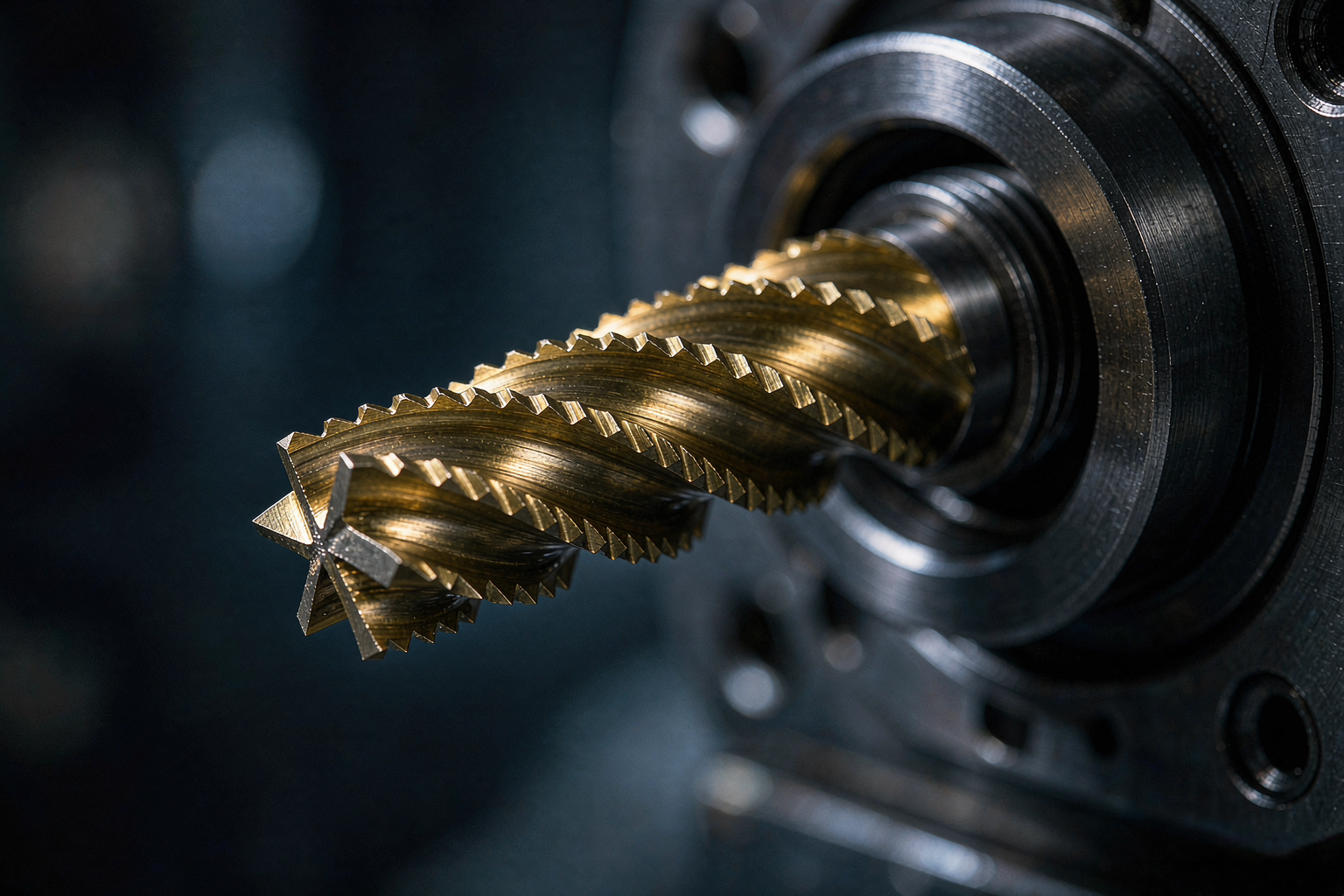
When a job quote is built around cubic inches per minute, the roughing end mill is the tool that decides whether you hit the hourly rate or watch the spindle babysit a light cut. A roughing end mill looks like a standard carbide end mill with its flutes chopped into waves — and that “damage” is the whole point. The serrated profile, usually called chip splitters or chipbreakers, slices each chip into short, manageable pieces so the cutter can take far deeper radial and axial engagement at much higher feed rates than a smooth-flute finishing end mill of the same diameter. This guide explains how chip splitter geometry works, how to pick flute count and pitch, where roughers fit against finishers, and which holders keep them from chattering the whole operation apart.
What a Roughing End Mill Actually Does
Every end mill removes metal by forming chips, and chip thickness is the currency of the process. A finishing end mill with smooth flutes produces one long, continuous chip per flute per revolution. At heavy engagement, those chips pack flutes, weld to cutting edges, generate heat, and force you to back off the feed. The roughing end mill solves this by cutting the same amount of material while splitting each chip into short segments along its length.
The serrations on the cutting edge do not make the slot wider or rougher at the walls — a common misunderstanding. The outer envelope of the cutter is still round and sized to nominal diameter, so a rougher can leave roughly 0.3–0.5 mm of stock for a finishing pass without hurting final accuracy. What the wavy profile changes is chip formation: each segment of the edge enters and exits the cut at a slightly different radial position, so the chip breaks rhythmically instead of forming one long string. Shorter chips evacuate better, carry less heat back into the edge, and let you run feed rates two to three times higher than a smooth-flute cutter at the same depth of cut.
Chip Splitter Geometry: Pitch, Profile and Radial Depth
Coarse Pitch vs Fine Pitch
Roughing end mills come in coarse (large) and fine (small) chip splitter pitch. Coarse pitch means fewer, deeper serrations: each edge segment takes a bigger bite, which suits soft, gummy materials like low-carbon steel and aluminum where you want aggressive chip thinning and high metal removal. Fine pitch means more segments per revolution sharing the load — the right choice for hard materials, titanium and stainless, where edge loading and chipping are the failure modes you fear more than chip packing.
A practical starting point: for steels under ~30 HRC, coarse pitch with 3–4 flutes; for pre-hardened mold steel and aerospace alloys, fine pitch with 4–6 flutes. If chips come out in long tangled birds’ nests, your pitch is too fine for the feed you are running; if edges chip within the first few slots, drop to finer pitch and reduce radial engagement.
Corrugated vs Straight Serration Profile
Two serration styles dominate. Corrugated (wavy) profiles alternate segments in and out along the helix, which spreads wear around the perimeter and gives the characteristic “ripple” left on the walls of the roughed slot. Straight or stepped profiles remove material in discrete stepped bands and are more common on insert-style and high-feed roughers. For solid carbide roughing end mills, corrugated is the mainstream choice because the transition between edge segments is smoother, cutting forces fluctuate less, and the wall finish left for the semi-finish pass is more uniform.
Roughing vs Finishing End Mill: The Comparison That Matters
Shops often ask whether they can just run one end mill for everything. Sometimes they can — at the cost of cycle time or tool life. The table below summarizes where each tool wins:
| Attribute | Roughing End Mill | Finishing End Mill |
|---|---|---|
| Edge geometry | Serrated chip splitters | Smooth, sharp ground edges |
| Chip form | Short, segmented, easy to evacuate | Long, continuous ribbon |
| Max radial engagement | Up to full diameter in slotting, 20–50% typical | Light, usually under 10% radial |
| Feed rate potential | 2–3x higher than a finisher of the same dia. | Moderate; limited by chip evacuation |
| Wall finish | Rippled, leaves 0.2–0.5 mm stock | Direct-to-size, Ra suitable for seals and fits |
| Best for | Stock removal, deep pockets, hard alloys | Final size, walls, floors, contours |
| Typical flute count | 3–6 | 2–4 (more for finishing corners) |
The economic logic is simple: pair a rougher that clears 80–90% of the volume fast with a finisher that touches only the last few tenths. Trying to rough with a finisher burns edge life and cycle time; trying to finish with a rougher produces walls that need a second operation anyway.
Flute Count, Helix and Chatter Control
Three, Four or Six Flutes?
Flute count trades chip room against edge support. Three-flute roughers maximize gullet space for aluminum and soft steel slotting. Four-flute roughers are the general-purpose default in steel and stainless. Six-flute fine-pitch roughers shine in titanium and hardened steel, where a higher number of engaged segments lowers the load per edge and stabilizes the cut at moderate feeds. More flutes also mean a stronger core — helpful when axial depth runs 1.5–2x diameter in a deep pocket.
Variable Helix and Uneven Spacing
Chatter is the rougher’s natural enemy because heavy engagement amplifies any harmonic between tool, holder and workpiece. Variable helix and uneven flute spacing break up the harmonic by ensuring each flute meets the work at a slightly different phase, damping regenerative vibration. If your roughing pass screams above 6,000 rpm even at conservative depths, a variable-helix rougher frequently solves it without touching speeds and feeds.
Coatings and Workpiece Materials
For unalloyed and low-alloy steels, a fine-grain TiAlN or AlTiN coating handles the abrasion and moderate heat of high-feed roughing. For stainless and titanium, prioritize a smooth, thick AlCrN-type coating with a sharp substrate edge prep — built-up edge, not flank wear, kills roughers in sticky alloys. For aluminum and non-ferrous work, an uncoated or DLC-coated polished-flute rougher prevents aluminum from welding into the serrations; polished flutes matter more than coating brand here. For hardened tool steel above 50 HRC, fine-pitch roughers with AlTiN nano-layer coatings and a tough carbide substrate hold up where general-purpose grades chip.
Speeds, Feeds and Radial Engagement Basics
Roughing end mills reward aggressive parameters but punish guesswork. Three rules cover most situations:
- Run chip load, not rpm. Size feed so each edge segment takes its designed chip thickness; too light a feed rubs and work-hardens the surface, especially in stainless.
- Balance radial and axial depth. The classic high-efficiency pairing is 20–30% radial engagement with 1.5–2x diameter axial depth — deep and narrow, not shallow and wide.
- Climb mill always. Conventional milling with a rougher smears the serration profile across the wall, doubles cutting forces and accelerates edge chipping.
When slotting at full diameter, halve the feed per tooth the datasheet suggests for side milling, and open up the axial depth instead. The chip splitters already divide the load; forcing full-diameter high feed in one pass is the fastest way to snap a carbide rougher in the cut.
The Holder Decides Whether the Rougher Performs
A carbide roughing end mill transmits high, fluctuating tangential loads into the spindle. Slip is the failure mode to design against: if the cutter pulls out or rotates mid-cut, the first symptom is usually a broken tool, not a dimensional error. Three holder families cover roughing well:
- Side-lock (Weldon flat) holders are the classic roughing choice — the set screw locks against the shank flat and positively prevents rotation. See our guide on side lock end mill holders and set screw torque for the details that keep the flat from brinelling.
- Power milling chucks combine high clamping torque with anti pull-out locking keys and suit shops that standardize on smooth-shank tools. We compared the trade-offs against collet chucks in the power milling chuck buying guide.
- Hydraulic and shrink-fit chucks give the best runout — valuable when the same job later switches to finishing — but verify the manufacturer’s rating for heavy roughing before committing them to daily stock removal duty.
Whatever the holder, check runout at the cutting edge, not just the shank. A rougher running 0.03 mm TIR puts one edge segment under double load, and fine-pitch roughers chip in exactly that scenario. Our article on ER collet runout and TIR grades explains how runout compounds through the toolholding chain.
Common Roughing Mistakes Worth Avoiding
- Using the rougher to final size. The serration envelope is nominal, but the rippled wall will never pass a tolerance check — always leave a finishing allowance.
- Ignoring pitch when switching materials. A fine-pitch titanium rougher loads up instantly in gummy mild steel; a coarse-pitch aluminum rougher chips on the first pass in hardened mold steel.
- Recutting packed chips. With air blast or coolant aimed wrong, segmented chips recirculate at the bottom of deep pockets and re-machine themselves into the edge. Direct the nozzle into the pocket, not along the wall.
- Running a worn rougher into the finish stock. Serrated edges wear fast once the substrate is exposed, and the rub-hardened layer left behind makes the finishing pass chip. Retire roughers on measured wear, not visual guessing.
Practical Selection Checklist
Before you order, answer five questions: What material and hardness? What radial and axial depths does the cycle plan assume? Slotting or side milling? Which holder family will carry the tool — and its rated torque? And what stock allowance will the finishing pass need? Match pitch to material, flute count to chip room, coating to heat, and holder to torque. Get those right and a quality roughing end mill will move metal at rates that make the finishing end mill look like a decoration on the tool crib wall.
Looking for a supplier that can match roughing end mills, side-lock holders and power milling chucks as one tested system instead of three separate purchases? Contact SCZY — we help machine shops pair the right cutter geometry with the toolholding that lets it run at full book values.



