
Most shops buy an ER collet chuck the same way they buy drill bits: pick the size that looks right on the shelf and hope. Then a 12 mm end mill starts slipping at 0.4 mm depth of cut, the runout gauge shows 25 µm, and the collet gets blamed for a problem that was really a sizing and torque decision made months earlier. An ER collet chuck is a simple device — a hardened collet with an 8° double-angle taper, squeezed by a nut — but it only performs when the collet size, clamping range, nut type and tightening torque all line up with the tool you are actually running. This guide walks through the ER family from ER11 to ER40, the numbers that matter, and the decisions that separate a holder that repeats to 5 µm from one that drifts.
What an ER collet chuck actually is
An ER collet is a slit spring sleeve ground with two opposing 8° cones, standardised under DIN 6499 / ISO 15488. The slots are cut from alternating ends so that when the nut pushes the collet into the holder’s 8° bore, the sleeve closes roughly parallel along its full length instead of tapering into a cone. That parallel closure is what gives ER its usable compression range — typically 1 mm per collet — and it is why one ER32 collet marked 6–5 mm can hold a 5.5 mm shank as safely as a 6 mm one.
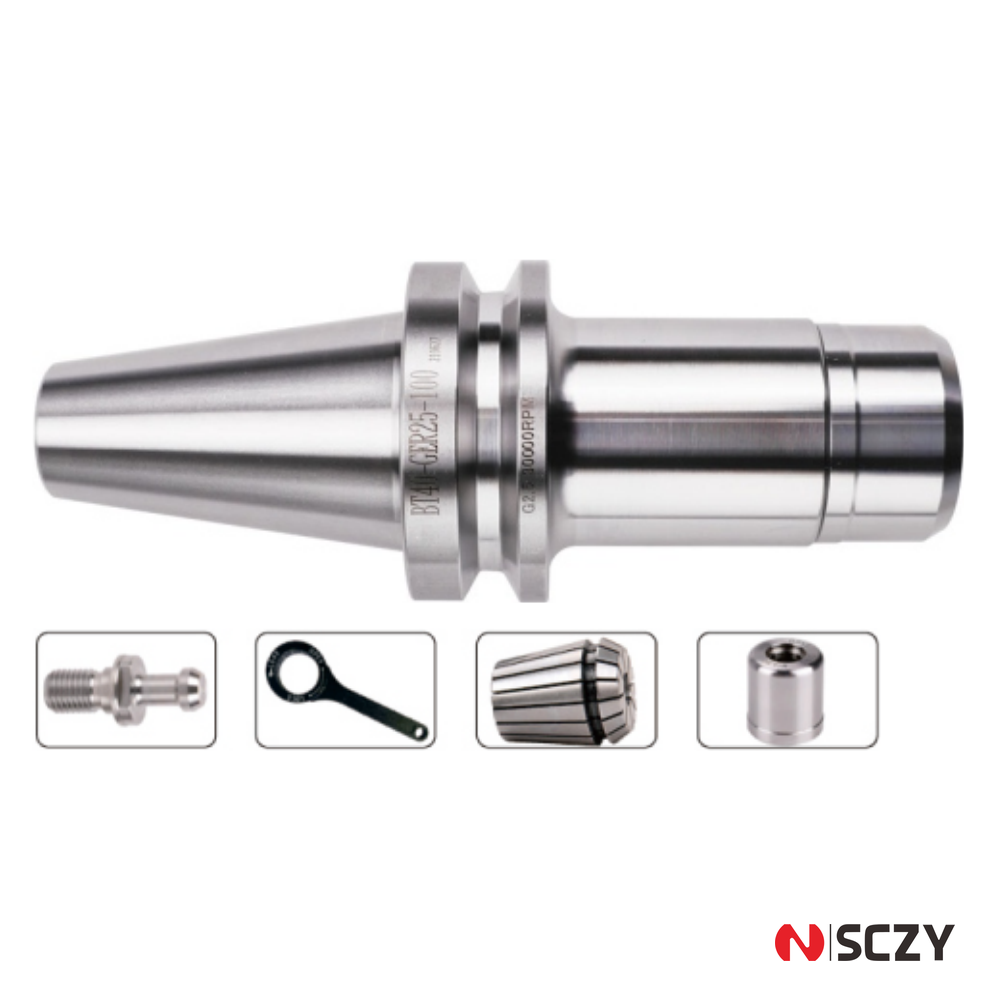
The chuck body is the other half of the system. It carries the 8° internal bore, an external thread for the nut, and a shank that matches your spindle — BT30, BT40, BT50, HSK-A63, or a straight shank for a collet block. In a proper assembly the nut does not spin the collet: a small eccentric ring inside the nut lifts the collet out of the taper as you loosen, which is what lets you change tools without tapping the collet loose with a punch.
The ER family in numbers
ER sizes are not interchangeable and they are not arbitrary: each step up buys shank capacity at the cost of body diameter, mass and tightening effort. The table below uses typical catalogue values for standard (non-high-speed) nuts. Always confirm against the holder supplier’s own data sheet, because nut design and balance grade move the speed limit considerably.
| Size | Clamping range | Typical shank held | Nut / body diameter | Nut torque (typical) | Practical speed limit* |
|---|---|---|---|---|---|
| ER11 | 1.0–7.0 mm | up to 6 mm / 1/4″ | 16 mm | ~12 N·m | ~50,000 rpm |
| ER16 | 1.0–10.0 mm | up to 10 mm / 3/8″ | 22 mm | ~35 N·m | ~40,000 rpm |
| ER20 | 1.0–13.0 mm | up to 13 mm / 1/2″ | 28 mm | ~60 N·m | ~35,000 rpm |
| ER25 | 1.0–16.0 mm | up to 16 mm / 5/8″ | 35 mm | ~90 N·m | ~30,000 rpm |
| ER32 | 2.0–20.0 mm | up to 20 mm / 3/4″ | 40 mm | ~135 N·m | ~25,000 rpm |
| ER40 | 3.0–26.0 mm | up to 25 mm / 1″ | 50 mm | ~175 N·m | ~20,000 rpm |
*With a balanced nut on a balanced holder. A standard nut on a 20,000 rpm spindle is the limiting component long before the collet is.
Reading the clamping range correctly
Two mistakes account for most ER failures. The first is clamping a shank at the extreme top of a collet’s range, where closing force is lowest and the collet is already near its open limit. The second is using a collet whose nominal size sits at the bottom of its band on a shank that is slightly undersize — a worn 6 mm end mill in a 6–5 mm collet closes on almost nothing, and the tool walks under load. If your shank measures 5.96 mm, use a collet size that holds it near the middle of its band rather than at the edge.
Choosing a size: start from the shank, not the holder
The right way to size an ER collet chuck is to work backwards from the largest tool you will realistically run in that position. If the answer is 12 mm, ER20 is the minimum and ER25 gives you margin. If it is 20 mm, ER32 is the practical floor — ER25 will not close on it at all. Going one size up costs body diameter, which matters on a small VMC with tight fixturing, and adds mass at the spindle nose, which matters for high-speed work.
The clearance test that catalogues never mention
Body diameter is not just a number for the spec sheet. On a 40-taper machine with a 90 mm facing head and a fixture wall 30 mm away, an ER40 chuck at 50 mm body diameter plus a nut that protrudes another 20 mm will hit the wall before the tool reaches the feature. Check the nut’s outside diameter and its projection length against the actual part, not against the drawing envelope. This single check prevents more tool changes than any runout specification.
Hex nut or bearing nut
Every ER chuck ships with a nut, and the nut you get changes performance more than most buyers expect. A standard hex nut transfers tightening torque through direct sliding friction between nut face and collet shoulder. A bearing (mini) nut places a rolling element between them, so far less of your wrench effort is lost to friction and more of it reaches the collet. The result is roughly 30–50% more clamping force at the same torque reading, plus lower runout scatter because the nut is not dragging the collet off-centre as it tightens.
Bearing nuts are the default choice above 10,000 rpm, for small-diameter tools in hard materials, and for any process where tool pull-out has ever been an issue. They are also smoother to operate, which quietly improves consistency across shifts — an operator who does not have to fight the wrench tends to tighten to spec rather than to “that feels about right”.
Torque: what under- and over-tightening actually do
Under-torque is the common failure. At half the rated torque, clamping force falls far more than proportionally, the collet does not fully seat in the 8° bore, and the tool creeps in Z under axial load — usually right at the moment a finishing pass starts, which is why the scrap shows up on the last cut. Over-torque is the quieter failure: it stretches the nut thread, bell-mouths the collet bore over time, and makes the next tool change harder than it should be. Use a torque wrench on the nut, not a length of pipe on a spanner, and re-check torque after the first few heat cycles on a new holder.
Runout: what the grade actually promises
Collet accuracy classes (A and AA under DIN 6499) describe the collet’s own geometry, measured under reference conditions. What your spindle sees is the sum of collet error, holder bore error, nut seating, and how clean the taper was when you loaded it. A 5 µm AA collet in a holder with 4 µm of bore error and a chip on the shoulder will not produce a 5 µm assembly. This is why the practical order of operations is: clean the taper, seat the collet, torque to spec, then measure at the tool — and why our guide to ER collet runout and accuracy grades treats the assembly, not the collet, as the unit of accuracy.
If your process needs better than about 10 µm at 3× diameter, ER is the wrong family. That is the point where a hydraulic or shrink-fit holder earns its price, and the comparison is worth making before you buy a second set of collets.
Integral shank or arbor mount
An ER collet chuck can be an integral holder with a BT or HSK shank ground on the same piece of steel as the 8° bore, or a separate chuck mounted on an arbor. Integral holders win on rigidity and runout because there is one fewer interface, and they are the right answer for production milling. Separate chucks make sense when you want to move one collet chuck between a lathe and a mill, or when the same chuck body must serve several spindle types in a repair shop.
Taper choice follows the machine, not the holder: BT30 for small VMCs and drill-tap centres, BT40 for general production, BT50 where heavy radial loads dominate, HSK-A63 where speed and repeatable face contact matter. The ER interface itself stays identical across all of them, which is why a shop can standardise on ER32 collets and buy holders in four tapers without duplicating tooling. Where clamping force and rigidity matter more than collet versatility, the same logic pushes you toward a side lock end mill holder or a power milling chuck instead.
Failure modes worth catching early
ER systems fail in predictable ways, and each has a visible warning. Collet slots pack with fines and stop the sleeve closing evenly — the symptom is runout that appears suddenly after a clean-looking tool change. Nut threads gall when the nut is run dry or tightened onto a dirty collet shoulder, which shows as a gritty feel at the last quarter turn. Holder bores bell-mouth at the small end when an operator repeatedly over-torques, and the fix is a new holder, not a new collet. A collet that has been dropped and shows a burr on the closing edge will never seat true again; retire it.
Coolant and ER collet chucks
ER collets grip on a slit sleeve, so coolant will find the slots. Standard ER holders are not sealed for high-pressure through-tool coolant, and pushing 70 bar through one usually results in coolant weeping around the nut rather than reaching the tool tip. If the process needs through-coolant, use a sealed collet system or a dedicated coolant-through holder, and reserve plain ER for flood and air-blast work. This is a limitation of the interface, not of any particular brand — the same reasoning applies when you compare drill chucks with keyed and keyless designs for coolant-heavy drilling.
A practical selection checklist
Before ordering, confirm seven things: the largest shank diameter the position will ever run; the collet band that holds that shank near its middle rather than its edge; the nut outside diameter and projection against the part and fixture; whether the nut is a bearing type; the rated torque for that nut size, plus a torque wrench to reach it; the balance grade required at your top spindle speed; and the taper that matches the machine. Get those answers and the holder choice stops being a guess.
SCZY supplies ER collet chucks in BT30, BT40, BT50 and HSK configurations, with standard and bearing nuts, matched to the collet range your tools actually need. If you are standardising a shop or replacing a mixed collection of holders, send us your tool list and spindle types — we will map it to a collet size and holder set that keeps one collet family across the whole floor, and quote a trial order around it.
Talk to our team about ER collet chuck sizing and a trial order.
GET A QUOTE
Looking for ER collet chucks that match your specs?
Explore our product range or send us your requirements. Our team will be glad to review your inquiry.



